
Bridging a Century of Engineering with Embodied Intelligence: Strategic Mandates for Today’s Robotics Leaders
Published:
Originally published on Substack.
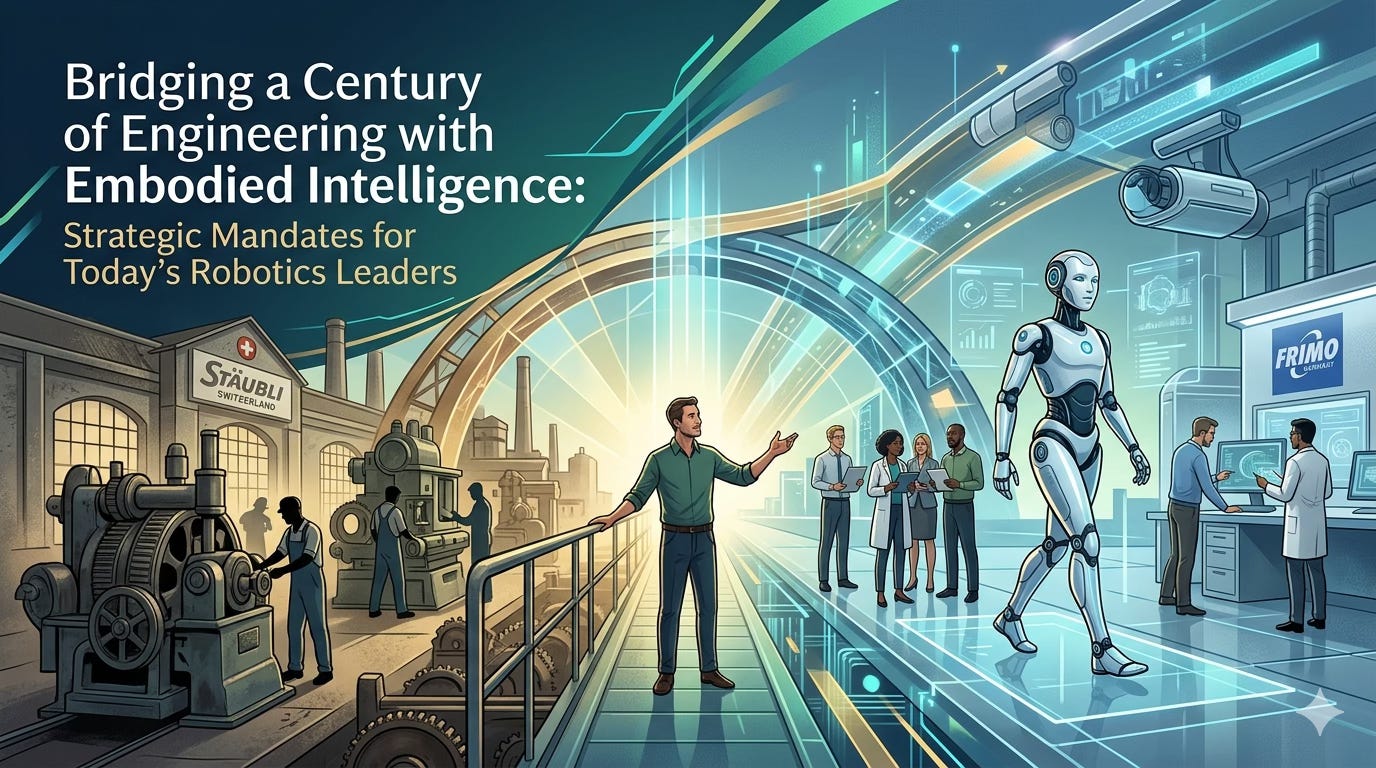
I’ve spent my career bridging worlds that rarely meet: the disciplined, century-old precision of Stäubli in Switzerland (founded in 1892, a global leader in industrial and mechatronic solutions) and the engineering excellence of Frimo in Germany (over 50 years building tools and equipment for plastic components). Then, in just five years, I built and exited two companies with many projects in China and the United States. After that, I joined a humanoid robotics startup that’s barely one year old.
This path isn’t a resume flex. It’s a front-row seat to what actually separates enduring organizations from those that flame out.
When you look across legacy industrial companies and early-stage startups, a pattern becomes clear. The difference isn’t just speed or scale—it’s philosophy.
Legacy companies teach you how to build things that last. Startups teach you how to build things that matter right now. The founders and executives who thrive are those who learn to carry the first discipline into the second environment—without letting it slow them down.
What Century-Old Companies Get Right (and What They Pay For It)
At Stäubli and Frimo, processes weren’t optional. They were the product.
Quality wasn’t a slogan—it was embedded in every drawing, every tolerance, every supplier audit. Decisions moved slowly because mistakes could echo for years. In industrial markets, reputation compounds quietly—and once lost, it doesn’t come back.
People stayed for decades. Knowledge didn’t sit in slide decks or individual heads; it accumulated across the organization.
This creates incredible resilience. These companies survive wars, recessions, technological shifts, and leadership changes. They know how to scale manufacturing, manage global supply chains, and protect intellectual property across borders.
But the same strengths become liabilities in fast-moving markets. Consensus takes time. Risk aversion is cultural. Innovation often means incremental improvement on proven platforms rather than questioning the platform itself.
When I moved from that world into building my own companies, the contrast hit immediately.
One thing they do exceptionally well is treating people as a long-term asset, not a short-term resource. When employees align with the company over time, motivation and stability follow. That’s what enables multi-decade thinking—what I’d call true “horizon strategy.”
But that kind of thinking is hard to maintain when the market is moving in months, not decades.
The Startup Crucible: Agility, Risk, and the Five-Year Sprint
Startups operate on a completely different clock.
In robotics, AI, and industrial tech, you’re often compressing what used to take decades into five-year cycles—build, scale, exit.
In that environment, leadership looks different. You’re constantly bridging hardware, AI, and software. You’re not just building products—you’re integrating systems that actually work in the real world.
From building OmniEdge (IIoT/VPN) and DeepFashion (AIGC), one thing became clear:
The value is not the hardware or software.
It’s the integration.
Most founders underestimate this. They focus on “cool tech,” but the real challenge is making everything work together reliably—and doing it before you run out of time or cash.
The hardest parts aren’t technical. They’re operational and existential: bottlenecks, cash flow, hiring mistakes, wrong bets.
Staying alive is the strategy.
The Brutal Speed of Building and Exiting in China and the US
In China, execution velocity is unmatched.
You can hire a team, iterate a product, and get customer feedback in weeks—not quarters. The market rewards speed and adaptability above almost everything else. But it also punishes sloppy foundations: weak IP protection, unclear equity structures, or teams without skin in the game can destroy value overnight.
The US offers a different advantage. Capital is more accessible. Talent density is higher. Customers are more sophisticated. You can test ideas with buyers who actually understand what they’re buying.
But there’s a tradeoff. The pressure for hyper-growth—and the “move fast and break things” mindset—can erode the discipline needed to build something that lasts.
I built and exited both companies in five years. The exits taught me something humbling: speed without durability is just expensive motion.
The things that actually mattered came from my time in Switzerland and Germany:
Process discipline prevented expensive mistakes
Respect for accumulated knowledge saved time
Long-term thinking made the companies more valuable to buyers
At the same time, startups forced me to let go of what didn’t work:
Too many approval layers
Over-engineering before validation
Fear of shutting things down
The Real Insight for Founders: Borrow Durability, Don’t Import Bureaucracy
If you’re a founder (especially one coming from big industry or corporate life), here’s what I wish someone had drilled into me earlier:
1. Process is a feature, not a bug—until it becomes the product.
Use the hard-won systems from legacy companies for things that compound: quality systems, financial controls, IP management, supplier governance. But ruthlessly question every other process. In a one-year-old humanoid startup, “how we did it at Stäubli” is only useful if it directly accelerates our ability to ship working robots that solve real problems today.
2. Build for both the sprint and the marathon.
Your first product needs to work in six months, not six years. But the company you’re creating should be capable of still being relevant in at least 10. That means hiring people who can move fast and think in decades. It means equity structures and culture that reward long-term ownership, not just quick flips.
3. Speed without judgment is chaos; judgment without speed is irrelevance.
Legacy experience gives you excellent judgment. The startup environment teaches you speed. The magic is combining them. I’ve watched founders from big tech or industry fail because they imported too much process and moved too slowly. I’ve also watched pure “zero-to-one” founders crash because they had no respect for durability—burning cash, talent, and trust until nothing was left.
4. Culture scales faster than technology.
In old companies, culture is often unspoken and inherited. In startups, you design it explicitly every day.
Take the best of both:
Craftsmanship and professionalism from industrial companies
Ownership and urgency from startup environments
For Managers in Big Companies: Your Next Move Might Be Smaller, Not Safer
If you’re sitting in a large organization wondering whether to make the leap, understand this: the skills that make you valuable in a 100+ year company—deep domain expertise, risk management, cross-functional coordination—are incredibly powerful in startups. But only if you’re willing to trade comfort for ownership.
The startups I built, the humanoid startup I used to work almost had no history. Every decision feels existential. There’s no “we’ve always done it this way” because there is no “always.” That’s terrifying and liberating.
What I carry from my past is perspective: how systems scale, where things break, how to build something that doesn’t collapse under pressure.
What I’m still learning is speed.
The Bottom Line
Legacy isn’t a burden or a luxury. It’s raw material. The best founders and forward-thinking executives don’t reject their corporate or industrial heritage—they refine it. They keep the parts that create lasting value (discipline, craftsmanship, long-term thinking) and shed the parts that create friction (bureaucracy, risk aversion, slow decision-making).
Whether you’re building the next century-old industrial giant or trying to ship the first truly useful humanoid robots this decade, the game is the same: create something that works today and can still work tomorrow.
The companies that endure aren’t the ones that never change. They’re the ones that change deliberately—carrying forward the hard lessons of history while staying hungry enough to write new ones.
What world are you building from? What will you leave behind to make it real? And are you ready to live with what the choice you make?