
Where the money comes from determines where the technology goes
Published:
Originally published on Substack.
I’m Yong (涌). I’ve spent over 20 years grinding in the trenches of industrial automation, robotics, and edge AI. I’ve programmed precision force-control loops for Stäubli in Switzerland, integrated heavy-duty robotics cells on automotive lines, and served as a humanoid robotics product leader defining next-generation platforms. Along the way, I’ve founded and exited three tech startups. If there is one thing this journey has taught me, it’s this: robotics is a brutal, capital-intensive game of physical survival. Cool demos get you clicks; but if your hardware cannot survive the heat, dust, and non-stop operational violence of a real factory floor, you are dead on arrival.
As we navigate the commercialization wave in 2026, the humanoid robotics and physical AI sectors are undergoing a massive geopolitical split. On one side of the Pacific, the United States is running an AI-first, capital-heavy “foundation brain” playbook. On the other, China is leveraging its absolute dominance in electromechanical supply chains to run a deployment-led, cost-optimized “hardware scaling” race.

Below is my raw, data-backed teardown of how the top 20 startups in both regions stack up when paper valuations collide with the cold realities of the assembly line.
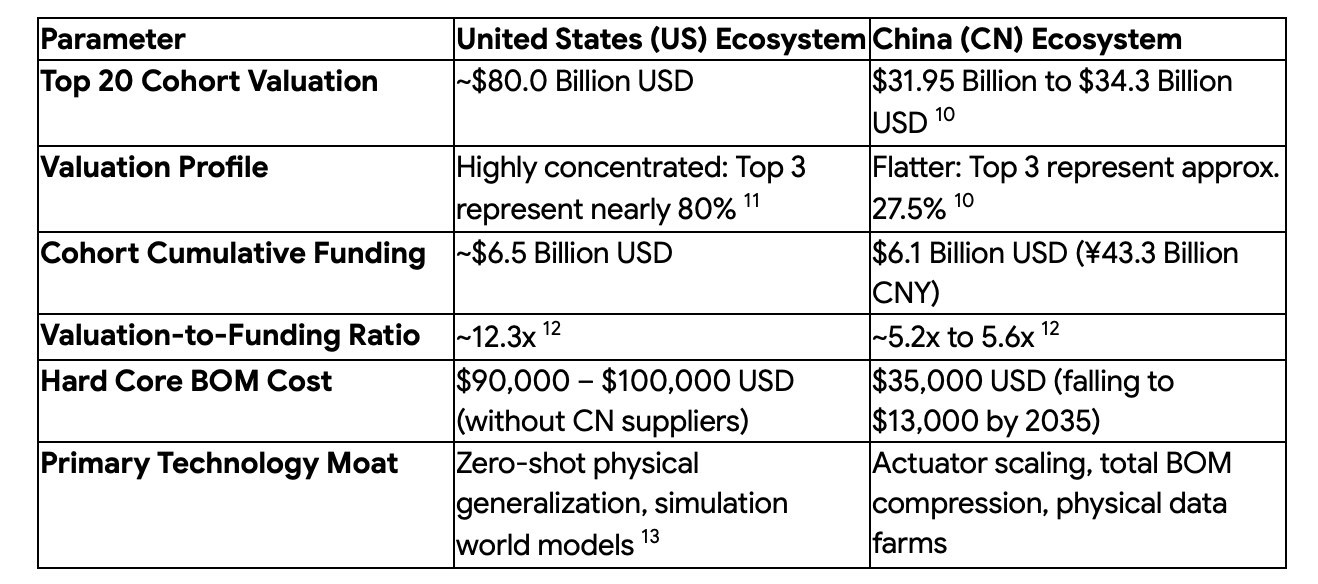
Comparative Structural Matrix: US vs. China Humanoid Ecosystems
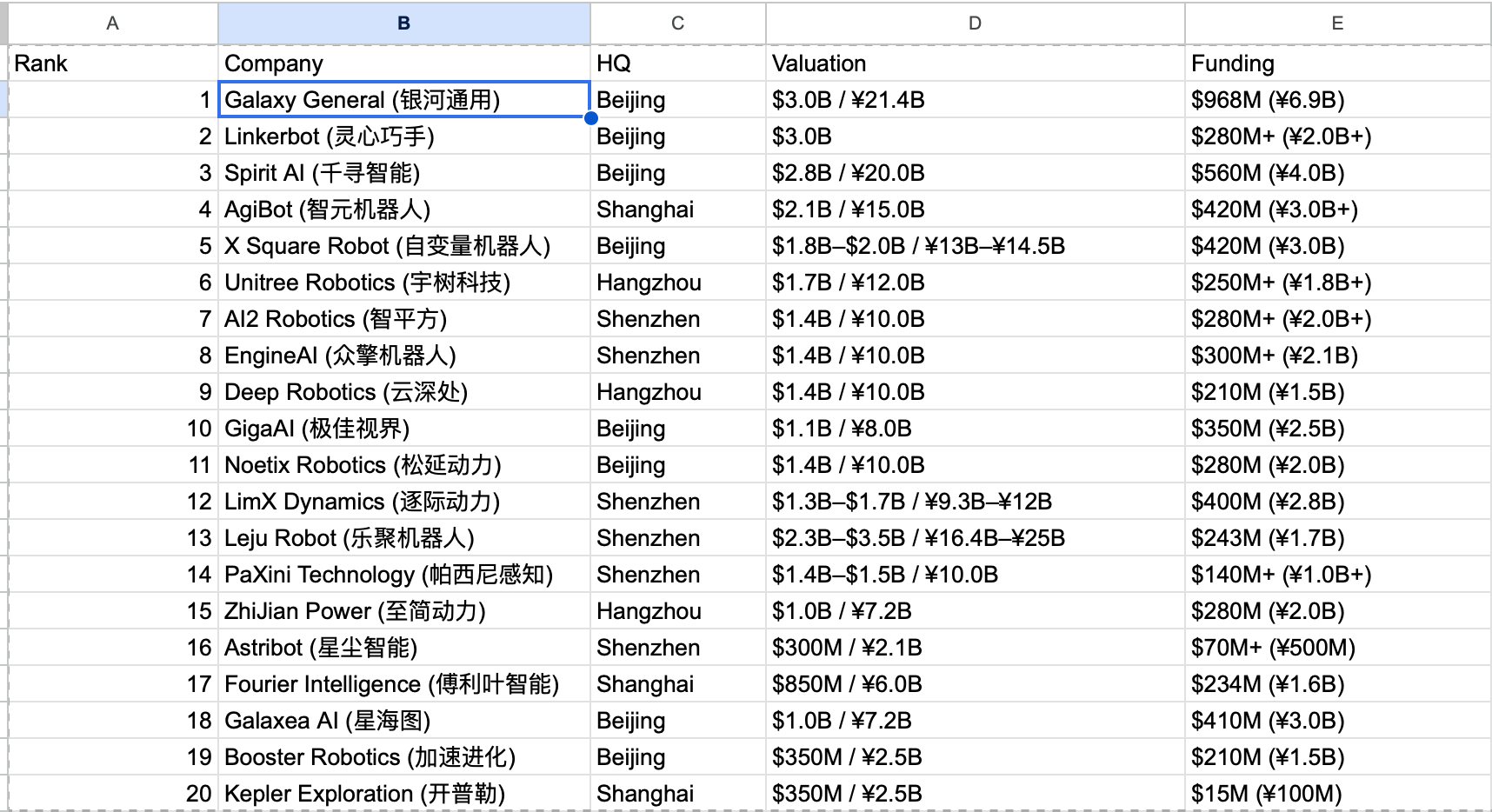
China Humanoid Robotics & Embodied AI Top 20 Cohort
1. Valuation Dynamics: Silicon Valley’s Oligopoly vs. China’s Flat Long-Tail
The way capital is distributed between these two ecosystems reveals a profound difference in regional geopolitical and financial strategy.11
Transatlantic Humanoid Valuation Concentration (Top 3 as % of Cohort):
United States (US): Figure AI ($39B) + Skild AI ($14B) + Physical Intelligence ($5.6B) = $58.6B (Approx. 80% of Top 20)
China (CN): Galaxy General ($3.0B) + Linkerbot ($3.0B) + Spirit AI ($2.8B) = $8.8B (Approx. 27.5% of Top 20)
The United States: A Billion-Dollar Oligopoly
The US physical AI ecosystem is exceptionally top-heavy.11 While the cumulative valuation of the top 20 US startups hovers around $80 billion, a staggering 80% of that book value is concentrated in just three platform-scale entities 11:
Figure AI commands a private valuation of $39.0 billion, driven by its Helix vision-language-action (VLA) model and its massive factory pilot at BMW’s Spartanburg facility.
Skild AI has reached a $14.0 billion valuation after SoftBank led a massive $1.4 billion Series C in January 2026 to fund its platform-agnostic “Skild Brain”.20
Physical Intelligence is valued at $5.6 billion, with active negotiations for a $1 billion round led by Founders Fund and Lightspeed targeting an $11 billion+ valuation.
The elite tier of US venture capital (Sequoia, General Catalyst, Thrive, Founders Fund) is not interested in funding a dozen different hardware assemblers. They are making a high-conviction bet to crown a select few software-first monopolies 20 that will license the “brains” of tomorrow to whoever builds the physical shell.
China: A Hyper-Competitive Net of Survivors
In contrast, China’s $31.95 billion to $34.3 billion startup cohort is incredibly flat.10 Its top three unlisted players 10:
Galaxy General (银河通用), building wheeled-bipedal systems, is valued at $3.0 billion.
Linkerbot (灵心巧手), the global dominant force in high-DoF dexterous hands, is valued at $3.0 billion (and is actively seeking a $6 billion valuation for its next round).
Spirit AI (千寻智能), focusing on next-gen universal embodied brains, is valued at $2.8 billion.
These three unlisted giants represent only 25.6% to 27.5% of the Chinese cohort’s total value.10 Even if you add the publicly traded UBTECH Robotics (market cap ~$7.0B) 10, the top-three concentration barely scratches 37% to 40%.10 China’s primary market supports a vast “long-tail” of over 150 active humanoid companies. Rather than crowning a single king early, Chinese investors let a massive network of component suppliers, bionic developers, and assembly specialists duke it out on the factory floor.
2. Geopolitics of Capital: State Guidance Funds vs. Big Tech Balance Sheets
Who funds your research dictates the parameters of your commercial execution.
China: The Rise of “Sovereign-Directed” Order Pipelines
In China, humanoid robotics is a state-level industrial mandate. More than 75% of China’s top 20 humanoid startups have direct state-owned capital, local government guidance funds, or national strategic platforms on their cap tables.
China’s Local Government Robotics War Chests:
1. Beijing Robot Industry Development Fund: ¥10.0 Billion
2. Hubei Humanoid Robot Parent Fund: ¥10.0 Billion
3. Shenzhen Embodied AI Fund Group: ¥3.0 Billion
Beyond the central government’s $138 billion state venture capital guidance fund, local municipals are highly aggressive in utilizing state funds to force localization:
In March 2026, the National AI Industry Fund (Big Fund Phase III) directly led a massive ¥2.5 billion strategic round for Galaxy General.
Heavyweight manufacturing and battery titans like CATL, BYD, and Luxshare Precision are strategically funding startups (e.g., CATL co-leading Galaxy General/GALBOT’s rounds, Luxshare co-leading EngineAI’s $200 million Series B).
This capital is not free money; it is a highly coordinated, order-driven pipeline. Startups get capital in exchange for deploying humanoid fleets directly on BYD car assembly lines, automating CATL’s battery production cells, or managing high-volume logistics hubs for JD.com and Shunfeng.
United States: Big Tech Hyperscalers and the Military-Industrial Shield
The US ecosystem is fueled by private tech balance sheets and the defense complex.
US private AI investment reached $109 billion—representing a 12-fold gap in private capital intensity compared to China’s $9.3 billion. Startups like Agility Robotics, Figure AI, and Apptronik are funded by the deep pockets of Amazon’s Industrial Innovation Fund, Microsoft, Google, and Nvidia.
Simultaneously, the US has a high-margin defense corridor that Chinese startups are completely barred from:
San Francisco-based Foundation Future Industries (FFI) secured $24 million in Pentagon research contracts to test its 176-pound Phantom MK-1 humanoid.
These tactical units were deployed directly in Ukraine for frontline logistics and reconnaissance testing—representing the first documented real-world combat deployment of humanoid hardware.
3. The Profitability Myth: Unitree’s Hardware Margin Moat vs. the Burn Rate
In my decades in the field, I’ve seen countless hardware companies go bankrupt because they designed beautiful products with zero path to positive gross margins.
2025 Financial Performance: Unitree vs. Competitors:
1. Unitree (Unlisted): ¥1.71 Billion Revenue | ¥600 Million Net Profit | 60.27% Gross Margin
2. UBTECH (HKG: 9880): ~¥2.0 Billion Revenue | ~¥790 Million Net Loss
3. Boston Dynamics: ₩3.28 Trillion Capital Injected | ₩440.5 Billion (~$320M) FY2024 Operating Loss
Unitree Robotics: The Cost-Down Outlier
According to the IPO prospectus submitted to the Shanghai STAR Market, Unitree Robotics has achieved something no other unlisted humanoid startup has managed globally: scale-level, self-sustaining profitability:
It pulled in ¥1.71 billion in 2025 revenue, netting an adjusted net profit of ¥600 million.21
Its gross margin escalated to 60.27%.
Unitree achieved this by refusing to outsource its bill of materials.21 They self-develop and vertically manufacture their planetary gearboxes, high-torque joint actuators, and electric motors in-house. This allows them to price their Unitree G1 humanoid at an aggressive $16,000 and still maintain high-margin unit economics. Moreover, over 73% of their humanoid revenues came from the high-margin, low-overhead academic research and developer markets, avoiding the costly custom-engineering drag of industrial deployment.
The Cash-Burn Reality of B-End Industrial Assembly
Outside of Unitree’s unique playbook, the humanoid landscape is a heavy cash-burn environment.
Even publicly listed UBTECH Robotics, which shipped a globally leading 1,079 full-size humanoids in 2025, ran an estimated net loss of ¥790 million on ¥2.0 billion in revenue. The immense overhead of customizing Walker S robots for specific automotive assembly lines eats away at software-style margins.
In the West, Boston Dynamics (majority-owned by Hyundai) continues to run deep losses, reporting a ₩440.5 billion (~$320 million) operating loss in FY2024 despite cumulative parent capital injections of ₩3.28 trillion. US venture-backed darlings like Figure AI, Apptronik, and 1X remain entirely pre-profit, utilizing their multi-billion-dollar cash runways to fund extreme R&D and high-talent acquisitions.
4. Supply Chain Gravity: The $131,000 “Optimus Penalty”
McKinsey’s April 2026 report laid bare the inescapable gravity of the Chinese manufacturing cluster:
Attempting to build Tesla’s Optimus Gen 2 entirely outside of China’s electromechanical supplier network results in a 3x cost penalty, with the Bill of Materials (BOM) surging from $46,000 to $131,000.
A typical humanoid robot assembled in China has an average BOM of $35,000 in 2026, on an aggressive trajectory to fall to $13,000 by 2035.
China’s Dominance in Key Humanoid Hardware Inputs:
1. Heavy Rare-Earth Processing (Motors): 99%
2. Permanent Magnet Market (Actuators): 93%
3. Electromechanical Component Supply: 80% ~ 90%
China controls 80% to 90% of key hardware components globally, 93% of the permanent magnet market essential for actuators, and 99% of the heavy rare-earth element processing required for high-torque robotic motors. This allows Chinese startups like 松延动力 (Noetix Robotics) to release its compact home humanoid “Dora/小布米” at a starting price under $1,400 (under 10,000 yuan), bypassing traditional, low-volume CNC machining bottlenecks.
5. Algorithmic Bifurcation: The “Zero-Shot Brain” vs. the “Data Pyramid”
When it comes to the “robotic brain” (cognitive model) and the “robotic hand” (dexterous manipulation), the US and China are executing completely different technological plays.
The US Pure-Play: Foundation Worlds and Semantic Generalization
The US strategy is built around high-compute simulation engines and native zero-shot generalization.
Physical Intelligence’s universal model, (released in April 2026), can operate highly complex, completely unfamiliar home appliances (like a specific model of an air fryer) after seeing it only twice in its entire training set.
US players leverage massive synthetic physics engines and world models. In Q1 2026 alone, $6 billion in venture capital flowed into dedicated world model developers, allowing robots to learn generalized motor skills within photorealistic simulations (such as NVIDIA Isaac Sim and AI Habitat) running at over 10,000 FPS on massive Blackwell compute clusters.
The Chinese Playbook: Pragmatic Data Acquisition and Hard-Target Tuning
China’s developers bypass high-compute simulation bottlenecks by industrializing physical data collection.
千寻智能 (Spirit AI) has bypassed traditional $20,000 teleoperation rigs by developing custom, 5th-generation wearable data-capture gloves that cut 数采 (data acquisition) costs to 1/10 of traditional methods.
Spirit AI has deployed a 1,000-person team to physically record over 200,000 hours of real-world physical interaction data (targeting 1 million hours in late 2026).
Chinese startups do not chase absolute, open-ended general intelligence. They focus on getting a robot to handle specialized, high-repetition industrial tasks—such as picking parts, sorting bins, and packing pallets—utilizing RAG (Retrieval-Augmented Generation) and custom physical training farms (such as the Hubei Humanoid Innovation Center).
6. Founders and Elite Pedigrees: Academic Giants vs. Serial Hustlers
The humanoid battle comes down to a high-wire tug-of-war between the elite minds of both nations.
The Chinese “Tsinghua-Berkeley” Academic Nexus:
1. Gao Yang (Spirit AI Co-founder) - Tsinghua CS, Berkeley BAIR PhD (Darrell / Abbeel Labs)
2. Chen Jianyu (RobotEra Founder) - Tsinghua, Berkeley PhD
3. Xu Huazhe (Galaxea AI Chief Scientist) - Tsinghua, Berkeley PhD
China’s Academic-Industrial Dream Teams
The core of China’s humanoid software brain layer is run by the highly concentrated “Berkeley Quartet” (伯克利归国四子)—a group of elite Chinese scholars who trained at the Berkeley Artificial Intelligence Research (BAIR) lab before returning to Tsinghua University’s Institute for Interdisciplinary Information Sciences.
These academic minds are systematically paired with veteran, battle-tested hardware operators:
Spirit AI pairs Chief Scientist Gao Yang (Tsinghua CS, Berkeley PhD under Trevor Darrell and post-doc under Pieter Abbeel) with CEO Han Fengtao, the former CTO of Luoshi Robotics (ROKAE) who personally led the delivery of over 20,000 industrial robotic arms across China.
The US Hall of Fame: Deep Learning Pioneers and Billion-Dollar Founders
The US founding teams represent the absolute pioneers of deep reinforcement learning and legendary Silicon Valley serial entrepreneurs:
Physical Intelligence was co-founded by Sergey Levine (UC Berkeley Professor, the most-cited academic in deep robotic learning) and Chelsea Finn (Stanford Professor, pioneer in meta-learning and MAML).22
Covariant was founded by Pieter Abbeel (Director of the Berkeley Robot Learning Lab).
Skild AI was founded by Carnegie Mellon University Professors Deepak Pathak and Abhinav Gupta.
These academic titans are joined by legendary Silicon Valley product builders, including Kyle Vogt (co-founder of Twitch and former CEO of GM’s self-driving division Cruise, now leading consumer humanoid play The Bot Company) 24, and Figure AI’s Brett Adcock (who previously founded Archer Aviation and Vettery).25
7. Real Capital Efficiency: What Does Your Dollar Buy?
The ultimate metric of any physical tech business is capital-to-physical-output efficiency. How much real, functioning industrial capability did your startup construct per dollar of capital raised?
AgiBot (上海智元) raised approximately $85 million in cumulative funding, yet successfully manufactured, shipped, and deployed over 10,000 physical humanoid units (including the general-purpose Expedition A3) as of late March 2026. This represents an incredibly lean capital-to-output yield of $8,500 in funding per deployed robot.
Unitree Robotics raised $237 million 12 and shipped 5,500 full-size humanoids in 2025 alone.
Figure AI has raised over $1.9 billion, but has manufactured and deployed only around 150 pilot-stage units to strategic partners like BMW. This implies an astronomical capital-to-output yield of $12.66 million in funding per shipped unit.27
Apptronik has raised nearly $1 billion ($976M) while shipping only early double-digit pilot units of its Apollo platform.
In China, every dollar raised is immediately converted into steel, copper, physical testing fields, and direct, on-site industrial testing. In the US, the vast majority of your venture dollar is burned in the virtual world: renting massive H100/Blackwell GPU clusters, hiring AI researchers at $1 million+ salaries, and training high-fidelity simulation world models that still face a massive sim-to-real transfer gap.
8. Yong’s Product Truths: Cut the Demo Bullshit, Get to the Factory Floor
Having spent 20 years in the automation trenches, I have zero tolerance for investor-facing PR stunts. Here is my unfiltered product advice on how to look at this industry before 2030:
“Dark Factories” (完全无人化工厂) are a VC hallucination.
If a factory manager buys a $150,000 humanoid robot that only has active battery runtimes of 2 to 4 hours per charge, losing precision when the factory lighting shifts or dust settles on its depth cameras, they will fire you on day one. Industrial buyers are brutally pragmatic. Standardized high-speed assembly tasks belong to 6-axis collaborative robotic arms. Humanoids only make economic sense in unstructured, low-payload, highly irregular environments where traditional rigid automation fails.The battle is won or lost at the fingertips (Dexterous Hands).
As Elon Musk noted, over 50% of the entire engineering and control workload of a humanoid robot is concentrated specifically on the hands. This is why 灵心巧手 (Linkerbot) commands a $3 billion valuation despite only building hands. If you cannot handle the complex force-feedback and micro-slip adjustments required to tighten a non-threaded screw or handle a flexible textile wire harness, your $100,000 robot is just a very expensive, slow-moving forklift.The Strategic End-State (2026–2030):
China is on track to win the physical hardware race. By dominating the electromechanical supply chains, cutting BOM costs to $13,000, and delivering thousands of units to academic, logistics, and retail spaces, China will commoditize the hardware shell of the humanoid robot.
The United States is on track to win the high-margin software brain race. If generalist VLA models (like Skild Brain or Physical Intelligence’s ) achieve true spatial-temporal reasoning and zero-shot generalization, they will establish a dominant “Robotics Android OS”. They will license this software globally, capturing 80%+ of the industry’s economic value while leaving Chinese hardware manufacturers fighting over low-margin assembly subcontracts.
The ultimate winner of this transatlantic hard-tech duel will be decided by a single question: Will the robotic “ChatGPT moment” be triggered by making the hardware incredibly cheap and physically robust, or by making the software brain completely generalist and physically aware? 27
Sourcing & Citations
SNE Research & IFR Industry Brief (2025/2026): Confirmed China’s control of 99% of heavy rare-earth processing, 93% of actuator magnetic materials, and over 75% state (state-owned capital) Cap Table representation.
Unitree Robotics (宇树科技) Shanghai STAR Market IPO Prospectus (March 2026): Verified FY2025 financial figures: ¥1.71B revenue, ¥600M net profit, 60.27% gross margin, and 5,500 humanoid shipments.
AgiBot (智元机器人) Partner Conference Disclosures (April 2026): Verified cumulative shipment milestone of 10,000 units by Q1 2026, and its ¥2.0B “Yuansheng” industrial ecosystem fund.
McKinsey & Co. Global Humanoid Supply Chain Analysis (April 2026): Detailed the 3x cost penalty for building Optimus outside China ($131,000 vs $46,000) and the BofA projection of $13,000 BOM cost by 2035.
1 Reuters Linkerbot (灵心巧手) Executive Interview (May 2026): Verified its 80% global market share in high-DoF dexterous hands, $3B Series B+ valuation, and its target $6B valuation round.
US Department of Defense (Pentagon) Procurement Portal (2026): Confirmed FFI’s $24M research contract for the Phantom MK-1, Eric Trump’s role as Chief Strategy Adviser, and its deployment for active logistics testing on the Ukrainian front lines.
Hyundai Motor Group SEC filings (FY2024/FY2025): Confirmed Boston Dynamics’ financial performance, including a ₩440.5B (~$320M) operating loss in 2024.
4 SEC & TechCrunch Unicorn Board (2025/2026): Verified the $39B private valuation of Figure AI, the $14B valuation of Skild AI after its $1.4B round, and Physical Intelligence’s $11B+ active raise parameters.
Works cited
After AI, China unicorns are eyeing global domination in robotic humanoids, accessed May 17, 2026, https://m.economictimes.com/news/international/us/after-ai-china-unicorns-are-eyeing-global-domination-in-robotic-humanoids/articleshow/130742840.cms
Chinese Startup Linkerbot Targets a $6B Valuation Amid the AI Robotics Boom - incrypted, accessed May 17, 2026, https://incrypted.com/en/chinese-startup-linkerbot-targets-a-6b-valuation-amid-the-ai-robotics-boom/
Chinese humanoid robot maker Linkerbot seeks $6B valuation | Semafor, accessed May 17, 2026, https://www.semafor.com/article/05/04/2026/chinese-humanoid-robot-maker-linkerbot-seeks-6b-valuation
Skild AI Robotics Manufacturing Foundation Model Raised $1.4B — and It’s a Threat to Every Automation Vendor - Medium, accessed May 18, 2026, https://medium.com/@creed_1732/skild-ai-robotics-manufacturing-foundation-model-raised-1-4b-bffbaad0e70e
Skild AI Stock: $14B Valuation — Is It a Buy? | TSG Invest, accessed May 18, 2026, https://tsginvest.com/skild-ai/
Skild AI Valuation Soars to $14B in Stunning Funding Round Led by SoftBank and Nvidia, accessed May 18, 2026, https://cryptorank.io/news/feed/edb5f-skild-ai-14-billion-valuation-robotics
Skild AI funding, news & analysis | Sacra, accessed May 18, 2026, https://sacra.com/c/skild-ai/
Physical Intelligence in Talks to Raise $1 Billion at $11 Billion Valuation - MLQ.ai | AI for investors, accessed May 18, 2026, https://mlq.ai/news/physical-intelligence-in-talks-to-raise-1-billion-at-11-billion-valuation/
Physical Intelligence eyes $1B raise at $11B valuation, Founders Fund and Lightspeed in talks, accessed May 18, 2026, https://techfundingnews.com/physical-intelligence-1b-raise-11b-valuation-founders-fund-lightspeed/
清华博士辍学造人形机器人:销售额已过亿,不想做短期套利, accessed May 17, 2026, https://m.mp.oeeee.com/a/BAAFRD0000202505301091115.html
Top Humanoid Robotics Startups by Valuation (2026) - New Market Pitch, accessed May 18, 2026, https://newmarketpitch.com/blogs/news/humanoid-robotics-top-startups-valuation
2026年4月,国内具身智能机器人企业融资情况汇总 - 维科号, accessed May 17, 2026, https://mp.ofweek.com/robot/a256714022697
Humanoid Robotics In 2026: The Race From Pilot To Platform - KraneShares, accessed May 18, 2026, https://kraneshares.com/humanoid-robotics-in-2026-the-race-from-pilot-to-platform/
Latest Progress of Seven Chinese Humanoid Robot Unicorns ..., accessed May 17, 2026, https://cnmra.com/latest-progress-of-seven-chinese-humanoid-robot-unicorns-valued-at-over-10-billion-in-2025/
Top 10 Chinese Humanoid Robots of 2026, accessed May 17, 2026, https://humanoidroboticstechnology.com/articles/top-10-chinese-humanoid-robots-of-2026/
未来科学城这个机器人“小孩哥”,又双叒叕火了!, accessed May 17, 2026, https://www.ncsti.gov.cn/kjdt/scyq/wlkxc/wldt/202504/t20250423_202596.html
Company Introduction-Noetix Robotics (Beijing) Technology Co., Ltd., accessed May 17, 2026, https://noetixrobotics.com/en/about-us
Dora - Humanoid robot guide, accessed May 17, 2026, https://humanoid.guide/product/dora/
China’s humanoid robot boom faces reality check as 150 companies chase a market where only 23% of buyers are satisfied - TNW, accessed May 17, 2026, https://thenextweb.com/news/china-humanoid-robot-boom-commercialisation-reality-check
估值破百亿!星动纪元完成10亿元战略融资—— - 国际科技创新中心, accessed May 17, 2026, https://www.ncsti.gov.cn/kjdt/scyq/zgckxc/zgcdt/202603/t20260310_240429.html
Will investors embrace China’s humanoid robot champion?, accessed May 18, 2026, https://www.ft.com/content/721e3bed-285b-46d4-8151-8cf28cb5ef50?syn-25a6b1a6=1
Physical Intelligence - 2026 Company Profile, Team, Funding & Competitors - Tracxn, accessed May 18, 2026, https://tracxn.com/d/companies/physicalintelligence/__1JIN2UI-QvpeC93FXAryqyydTalOe6C4uxMhHvwMhTw
Physical Intelligence Seeks $1 Billion as Robotics Interest Grows | PYMNTS.com, accessed May 18, 2026, https://www.pymnts.com/artificial-intelligence-2/2026/physical-intelligence-seeks-1-billion-as-robotics-interest-grows/
The Bot Company: Funding, Team & Investors | Startup Intros, accessed May 18, 2026, https://startupintros.com/orgs/the-bot-company
Figure AI Stock: $39B Valuation — Is It a Buy? | TSG Invest, accessed May 18, 2026, https://tsginvest.com/figure-ai/
Figure AI - Wikipedia, accessed May 18, 2026, https://en.wikipedia.org/wiki/Figure_AI
PUDU D7 | Semi-Humanoid wheeled AI-powered Robot for Industrial & Hospitality sectors, accessed May 17, 2026, https://www.pudurobotics.com/news/917