
Why Musk’s Visit to the Optimus Factory and Unitree’s IPO is a Win-Win for the Entire Industry ?
Published:
Originally published on Substack.
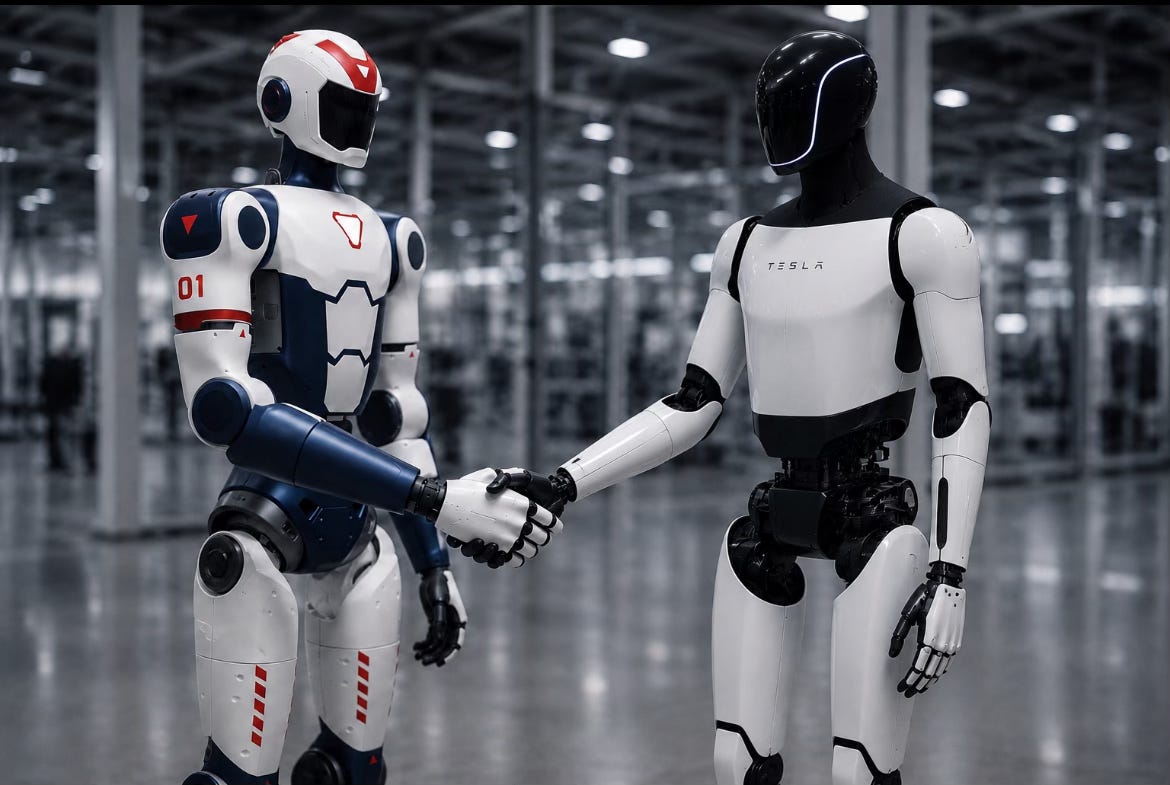
Signals Matter More Than Products
Viewed separately, these are simply two corporate milestones.
Musk appears at the Optimus production line in Fremont.
Unitree moves into the IPO registration process.
But viewed together, they appear to be sending the same message to the market.
For founders, signals influence fundraising.
For investors, signals shape expectations.
For an emerging industry, signals often reshape the market long before products do.
Startups Raise Confidence Before They Raise Capital
The biggest challenge for a startup is rarely technology.
It is the shortage of believers.
Investors wonder whether the market is real.
Suppliers question whether demand will last.
Customers worry about long-term support.
Banks worry about cash flow.
Top talent wonders whether the company will survive the next funding round.
Everyone is asking the same question:
Who else believes this will work?
The best startups do more than build products.
They build confidence in the future.
Musk Is Sending a Demand Signal
The most important part of Musk’s factory visit is not the photo.
It is the location.
A laboratory represents research.
A factory represents production.
Production represents procurement.
Procurement represents years of future orders.
To suppliers, an active production line is worth far more than a hundred product launches.
Because suppliers invest not in today’s revenue, but in tomorrow’s cash flow.
What Musk is signaling is not that humanoid robots have already succeeded.
He is signaling that the industry is now worth investing in.
Unitree Is Sending a Supply Signal
Unitree’s IPO carries a different message.
Many founders think of an IPO primarily as a financing event.
For manufacturing businesses, however, its greater value lies in reducing uncertainty across the entire commercial ecosystem.
Suppliers become more willing to expand capacity.
Customers become more comfortable signing long-term agreements.
Banks become more willing to extend credit.
Industrial investors become more willing to commit capital.
An IPO does more than raise money.
It tells the market that the company intends to be around for the long haul.
That certainty becomes a business asset in its own right.
Together, They Are Educating the Market
From a competitive perspective, it is easy to conclude that Tesla and Unitree are racing toward the same destination.
From an investor’s perspective, something else is happening.
Every new industry needs more than one successful company.
Without multiple market leaders, there is no stable supply chain.
Without a stable supply chain, there is no large-scale manufacturing.
Without scale, costs remain high.
And without lower costs, markets struggle to expand.
This was true for electric vehicles.
It was true for cloud computing.
It was true for smartphones.
Humanoid robotics is unlikely to be any different.
Together, They Reduce Supply Chain Risk
For suppliers, this is not an either-or decision.
Tesla scaling production means growing global demand.
Unitree going public means more stable demand from China.
Whether orders come from America or China is not the deciding factor.
The real question is whether future demand is becoming more predictable.
When both companies send long-term commitment signals at the same time, suppliers gain confidence that humanoid robotics is no longer a temporary trend.
It is becoming a sustainable industry.
That confidence encourages new factories.
New equipment.
New R&D investment.
Those investments reduce manufacturing costs across the entire ecosystem.
In the end, the beneficiaries are not only Tesla or Unitree.
Every company entering the industry stands to gain.
What Changes Is Market Expectation
Investors rarely invest in today’s business.
They invest in the speed at which tomorrow’s market will emerge.
An industry does not truly take off because one company succeeds.
It takes off because participants begin believing that others will succeed as well.
Economists describe this as coordinated expectations.
Once that shared expectation takes hold, the independent decisions of thousands of companies reinforce one another, pushing the industry toward a new equilibrium.
That is why the valuation of the same company can increase tenfold within a few years.
The technology may remain largely unchanged.
What changes is the market’s expectation.
One Validates Demand. The Other Validates Supply.
The most interesting aspect of these two events is not who moved first.
It is how each reinforces the other.
Musk’s factory visit validates demand.
Unitree’s IPO validates supply.
One strengthens confidence that a market exists.
The other strengthens confidence that the industry can support it.
Together, they reduce uncertainty across the entire robotics ecosystem.
Win-Win Is How Industries Mature
For founders, this makes fundraising easier.
For investors, it lowers perceived risk.
For suppliers, it justifies expanding capacity.
For the robotics industry, it marks the crossing of a far more important threshold.
Not a technological threshold.
A confidence threshold.
Industries rarely explode because of a single breakthrough product.
They grow because enough people begin believing the market will exist for decades.
Capital follows.
Supply chains expand.
Costs decline.
Demand accelerates.
A self-reinforcing cycle begins.
Years from now, few people will remember which production line Musk toured or the exact date Unitree filed for its IPO.
What they may remember instead is that this was the moment when capital, manufacturing, and supply chains all reached the same conclusion:
Humanoid robotics was no longer an experiment.
It had become a long-term business.