
Zhiyuan Robotics’ Acquisition Strategy Dramatic Industry Shifts Driven by Capital Leaps and Ecosystem Overhaul
Published:
Originally published on Substack.
Executive Summary
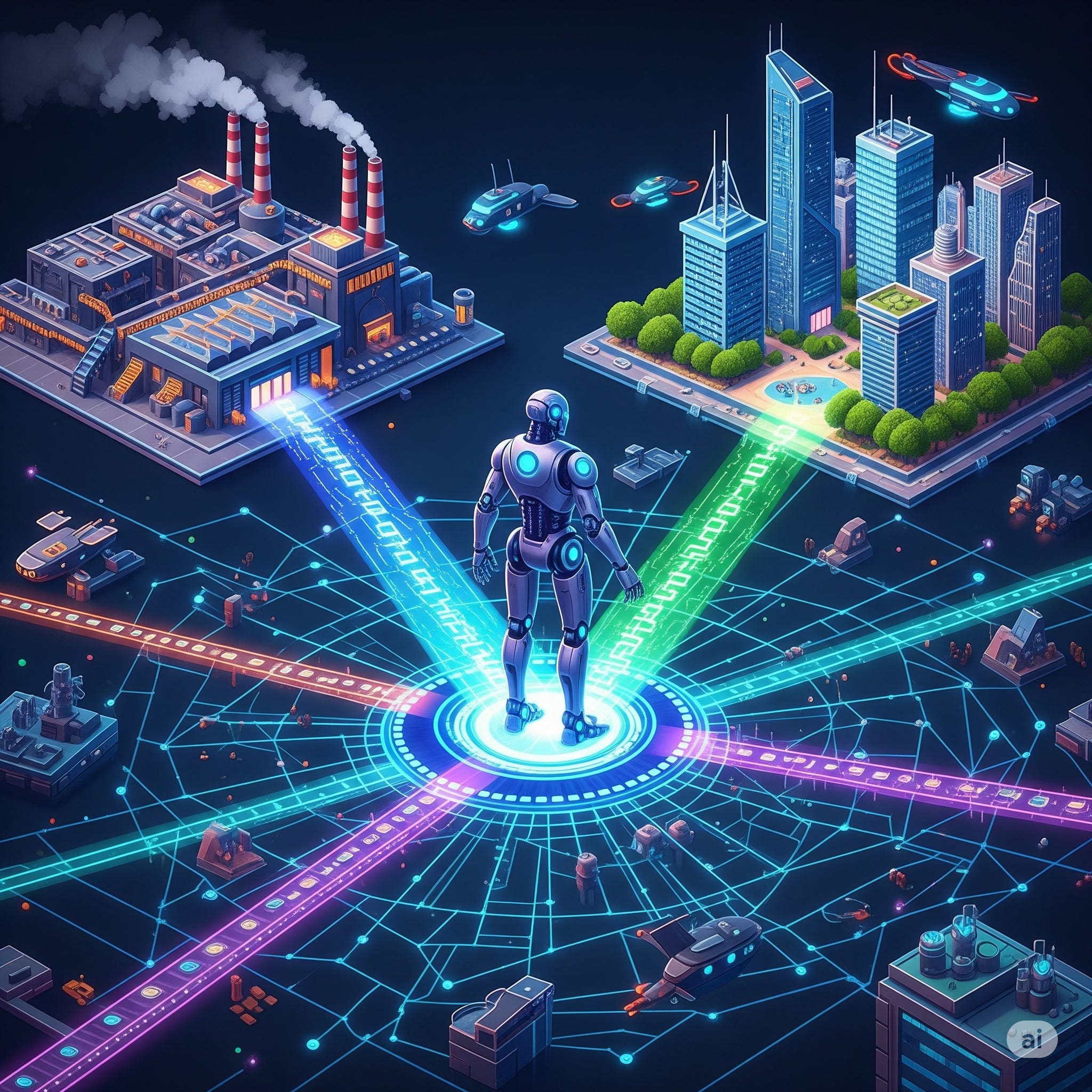
Zhiyuan Robotics' recent dual acquisition strategy signals a profound shift in the embodied AI sector, moving beyond singular technological breakthroughs to comprehensive ecosystem building. Through its controlling stake in Sunwoda New Material, Zhiyuan Robotics swiftly gained access to an A-share listing platform, achieving efficient capital leverage. This move also vertically integrated the core material supply chain for robotics, significantly reducing hardware costs and enhancing product performance. Concurrently, the light-asset equity investment in Yushu Intelligent(300815) allowed Zhiyuan to secure vast urban service scenarios with minimal outlay, providing invaluable data resources for training and commercializing large embodied AI models.
This "heavy and light" capital deployment not only established formidable supply chain, data, and capital barriers for Zhiyuan Robotics but also, bolstered by favorable policies, accelerated its transformation from a technological pioneer to an industry ecosystem leader. However, Zhiyuan Robotics' rapid ascent and ecosystem dominance also pose severe challenges for smaller startups valued under 1 billion RMB, intensifying the industry's resource gravitational pull and widening the mass production gap. This report will delve into Zhiyuan Robotics' strategic rationale, its far-reaching impact on the industry landscape, and analyze potential survival and growth pathways for small and medium-sized enterprises amidst this dramatic shift.
I. Zhiyuan Robotics' Dual Acquisition Strategy: Capital Leap and Ecosystem Restructuring
Zhiyuan Robotics has demonstrated its resolve and capability to rapidly build a competitive edge in the embodied AI sector through two seemingly distinct yet highly synergistic acquisitions. These strategic investments—one focused on "heavy asset" vertical integration and capital platform acquisition, the other on "light asset" scenario positioning and data value extraction—collectively weave a dual-track ecosystem network spanning "resources and scenarios."
1.1 Heavy Asset Control of Sunwoda New Material: Vertical Integration and Maximized Capital Efficiency
Zhiyuan Robotics and its management team plan to invest approximately 2.1 billion RMB to acquire a 63.62% stake in Sunwoda New Material (stock code 688585.SH). The announcement of this transaction on the evening of July 8th led to Sunwoda New Material hitting its daily 20.05% trading limit on July 9th, its first day back on the market. Subsequently, the value of this equity quickly surged to 3.6 billion RMB, yielding a paper gain of 1.5 billion RMB for Zhiyuan Robotics. The stock price later soared above 40 RMB per share, more than five times the acquisition price, indicating that the value of the intended acquisition has surpassed 10 billion RMB, with a paper gain exceeding 8 billion RMB.
1.1.1 Strategic Intent: Bypassing Lengthy IPOs, Rapidly Securing A-Share Financing Platform
The core strategic intent behind Zhiyuan Robotics' move is to efficiently gain access to an A-share financing platform, thereby circumventing the lengthy and uncertain review process of traditional IPOs. As a company established just two years ago , Zhiyuan Robotics has already achieved a valuation exceeding 15 billion RMB and has raised over 2.7 billion RMB in cumulative financing within eighteen months. In the capital-intensive embodied AI sector, continuous financial support is crucial. By going public through a backdoor listing, Zhiyuan Robotics can quickly convert its high private market valuation into public market liquidity and reduce future financing costs.
The positive market reaction to Sunwoda New Material, viewing it as the "first embodied AI stock" , fully validates Zhiyuan Robotics' strategy of rapidly establishing market dominance. This is not merely about acquiring a listing platform; it's also an arbitrage play on capital market valuation disparities, while simultaneously signaling Zhiyuan Robotics' aggressive expansion to the industry and investors. This swift capital market maneuver injects powerful financial momentum into its future development.
1.1.2 Industrial Synergy: Cost Reduction, Lightweighting, and Global Market Expansion
Sunwoda New Material's main business encompasses environmentally friendly high-performance corrosion-resistant materials, wind turbine blade materials, and new composite materials, widely used in sectors like wind power, automotive, and electronics. In robot manufacturing, high-performance resin materials account for approximately 40% of the total cost . By gaining control of Sunwoda New Material(688585), Zhiyuan Robotics anticipates reducing hardware costs by 30%. More importantly, this integration is expected to address critical pain points in humanoid robots: lightweighting (reducing weight by up to 70%) and extending battery life. For instance, Sunwoda New Material's PEEK material, due to its lightweight properties, can significantly lower humanoid robots' energy consumption and maintenance costs, demonstrating immense application potential.
This vertical integration strategy allows Zhiyuan Robotics to achieve independent control over its critical material supply chain, reducing reliance on external suppliers and enabling customized development of high-performance materials to meet its specific needs. In the nascent and rapidly scaling embodied AI industry, this builds a robust "hard barrier," making it difficult for competitors to match its material costs and performance, thereby strengthening Zhiyuan Robotics' competitive advantage in large-scale production.
Furthermore, Sunwoda New Material boasts a global client network, including Siemens Gamesa. Sunwoda New Material's strategic collaboration with Siemens Gamesa on recyclable wind turbine blade resins highlights its strength and international influence in advanced materials. Through this acquisition, Zhiyuan Robotics can directly leverage Sunwoda New Material's established international business and client relationships , paving the way for its future expansion into overseas markets. This effectively mitigates Zhiyuan Robotics' risks in entering global markets, allowing it to accelerate market penetration in international industrial sectors by utilizing Sunwoda New Material's existing reputation and channels.
1.2 Light Asset Equity Investment in Yushu Intelligent: Scenario Positioning and Data Value Mining
Zhiyuan Robotics' affiliated company, Zhiyuan Innovation (Shanghai) Technology Co., Ltd., recently invested 2.63 million RMB to acquire a 5% stake in Shenzhen Yushu Smart Robot Co., Ltd.. Yushu Intelligent is 95% controlled by Yuhotian (Shenzhen) (300815)Smart Technology Investment Co., Ltd., a subsidiary of the Yuhotian Group. Yuhotian Group, a large urban service provider, operates in over 200 cities and manages more than 500 environmental sanitation projects.
1.2.1 Tactical Logic: Mitigating Heavy Asset Investment Risks, Securing Scalable Scenario Resources
The tactical logic behind this investment is to leverage Yuhotian Group's vast urban service scenario resources with minimal capital outlay. Zhiyuan Robotics avoids the heavy asset investment and operational risks associated with directly entering the urban service sector. Instead, it integrates its technological capabilities with Yuhotian's practical scenario needs through an equity partnership.
This "light asset" model is essentially a "data-for-equity" strategy. Zhiyuan Robotics, through a small equity investment, gains a pass to large-scale real-world application scenarios, which is more capital-efficient than directly acquiring a service operation company. This indicates that Zhiyuan Robotics understands that in the age of AI, the strategic value of data and scenarios far outweighs mere asset ownership.
1.2.2 Data Value: Providing a Real Training Ground for "Smart Environmental Sanitation Large Models"
Yuhotian Group's annual revenue of 7.2 billion RMB means its large-scale urban service operations generate massive amounts of real-world data daily. This data provides an unparalleled training ground for Zhiyuan Robotics to develop its "Smart Environmental Sanitation Large Model". This large model aims to achieve intelligent scheduling of equipment clusters, environmental risk prediction, and autonomous optimization of operational routes , thereby accelerating the commercial validation and deployment of embodied AI technology in urban services.
Acquiring large-scale, high-quality real-world data is crucial for embodied AI large models to overcome the "reality gap." Through deep collaboration with Yuhotian, Zhiyuan Robotics can rapidly iterate and optimize its AI algorithms, forming a powerful "data-driven commercialization flywheel": more real-world deployments generate more data, data feeds back into model optimization, improved model performance drives more applications, which in turn collects more data. This virtuous cycle significantly shortens the AI model development cycle and commercialization path, giving Zhiyuan Robotics a significant leading edge in practical embodied AI.
II. Strategic Logic: From "Single-Point Technology Breakthrough" to "Industrial Ecosystem Hegemony"
Zhiyuan Robotics' dual acquisitions are not isolated incidents but central to its strategy of building industrial ecosystem hegemony and transforming from a technology innovator to an industry leader. This transformation is accelerated by policy support and fortified by the construction of multiple barriers, creating an inimitable competitive advantage.
2.1 Policy-Driven Expansion: Riding the Policy Wave, Forming a "Technology-Capital-Policy" Triangle
Zhiyuan Robotics' strategic expansion aligns closely with recent Chinese government policies supporting mergers and acquisitions (M&A) and restructuring of technology companies. The "Six M&A Guidelines" issued by the State Council explicitly support listed companies in paying transaction consideration through phased issuance of shares and convertible bonds, and in phased financing, to enhance transaction flexibility and capital efficiency, thereby facilitating more M&A deals. This provides policy-level support and convenience for Zhiyuan Robotics' backdoor listing of Sunwoda New Material.
Concurrently, the "Three-Year Action Plan for Accelerating the Development of High-Growth Enterprises in Shanghai (2025-2027)," issued by the Shanghai Municipal Commission of Economy and Information Technology, explicitly supports unicorn companies in optimizing their industrial ecosystems through M&A and restructuring, promoting technological progress and independent innovation. It also encourages securities firms, asset management companies, and equity investment funds to establish M&A funds to provide financial support to enterprises.
Zhiyuan Robotics has leveraged these policy tailwinds to complete the first backdoor listing by an embodied AI company in China. This is not merely about receiving policy support; it's about strategically utilizing policy as a tool to form a "technology-capital-policy" closed loop. This proactive alignment with national strategies and local policies allows Zhiyuan Robotics to gain fast-track regulatory approval, favor from state-owned capital, and a legitimate narrative, further attracting investment and top talent, thereby setting higher entry barriers for competitors.
2.2 Building an Ecosystem Niche with Triple Barriers: Hard, Soft, and Capital Leverage
Through its heavy asset control of Sunwoda New Material and light asset equity investment in Yushu Intelligent, Zhiyuan Robotics has cleverly constructed a multi-layered ecosystem moat, making its embodied AI niche difficult for competitors to replicate.
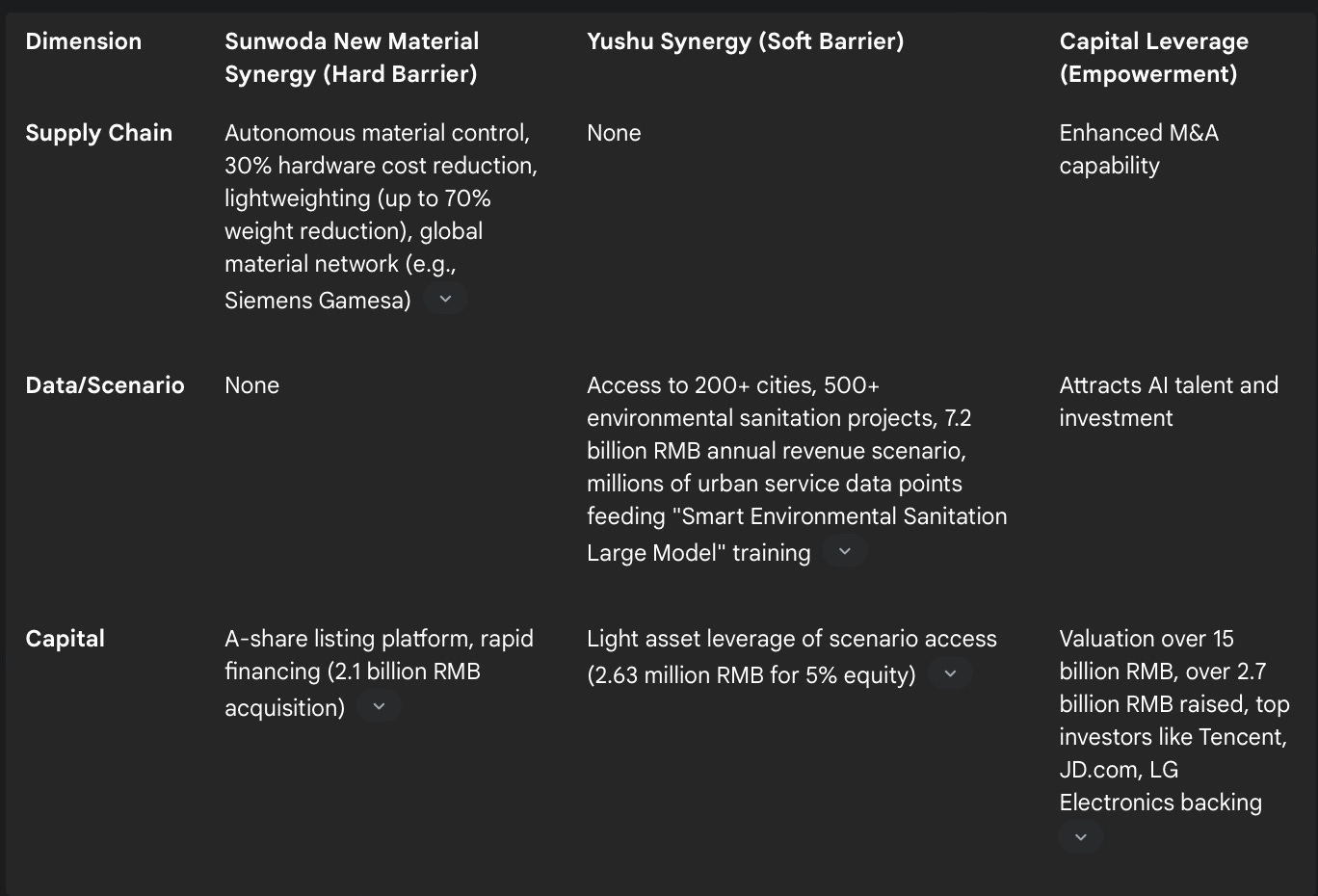
Hard Barrier: Autonomous Material Control and Cost Advantage Controlling Sunwoda New Material enables Zhiyuan Robotics to achieve autonomous control over core robot materials, projected to reduce hardware costs by 30%. Sunwoda New Material's expertise in high-performance resins and composite materials helps Zhiyuan Robotics achieve product lightweighting, improving battery life and motion performance. This deep integration into the upstream critical supply chain ensures Zhiyuan Robotics' product leadership in performance and cost, forming a solid "hard barrier."
Soft Barrier: Scenario Data Feedback and Accelerated AI Iteration The equity investment in Yushu Intelligent provides Zhiyuan Robotics with an exclusive stream of large-scale, real-world urban service scenario data.Yuhotian's annual revenue of 7.2 billion RMB means its business scenarios can continuously generate millions of environmental sanitation operation data points. This real data is crucial for training and optimizing the "Smart Environmental Sanitation Large Model" , accelerating AI algorithm commercialization and iteration, thereby forming a powerful "soft barrier." This data-driven AI capability enhancement is beyond the reach of competitors lacking real-world scenario data accumulation.
Capital Leverage: Listing Platform and Light Asset Prowess The A-share listing platform gained through Sunwoda New Material significantly boosts Zhiyuan Robotics' financing capabilities. This enables it to continuously secure substantial capital support, further solidifying its advantages in R&D, manufacturing, and market expansion. Simultaneously, the light asset investment in Yushu Intelligent (2.63 million RMB) leveraged Yuhotian Group's vast scenario access covering over 200 cities , demonstrating Zhiyuan's shrewdness in efficiently acquiring strategic resources through capital leverage.
These barriers are not isolated; they mutually reinforce each other, collectively building a powerful "ecosystem flywheel." Strong capital capabilities support strategic M&A and investments, leading to supply chain control and large-scale scenario data. Optimized supply chains and data accumulation, in turn, enhance product performance and AI capabilities, making products more competitive, which then attracts more capital and market share. This self-reinforcing cycle allows Zhiyuan Robotics to rapidly establish dominance in the industry.
Zhiyuan Robotics Ecosystem Barriers at a Glance
III. Industry Impact: Squeezing the Survival Space for Companies Under 1 Billion RMB
Zhiyuan Robotics' aggressive rise and ecosystem-building strategy have profoundly disrupted the existing embodied AI landscape, particularly posing immense survival pressure on small and medium-sized startups valued under 1 billion RMB.
3.1 Resource Black Hole Effect: Capital Overwhelm and Mass Production Chasm
Embodied AI is a classic capital-intensive industry, requiring enormous financial investment from hardware R&D and software algorithms to large-scale mass production. Zhiyuan Robotics, established for only two years, is already valued at 15 billion RMB and has raised over 2.7 billion RMB in financing within eighteen months, with continuous backing from giants like Tencent, JD.com, and LG Electronics. Industry data shows that among the 7.5 billion RMB total financing in the embodied AI sector, leading companies account for over 60%, while long-tail companies raise less than 100 million RMB annually. Industry experts explicitly state that for humanoid robot companies, if financing is below 1 billion RMB, they will face "immense challenges" because supply chain integration, resource allocation, and AI investment—including vision, navigation, and vertical domain models—all require substantial capital. This indicates that capital has become the primary barrier to survival and development in the embodied AI sector.
This extreme concentration of capital creates a powerful "resource black hole effect." Core elements such as funding, top talent, and supply chain resources are rapidly converging towards leading companies like Zhiyuan Robotics, making it incredibly difficult for smaller enterprises to secure necessary resources. This is not just market competition; it's the setting of a survival threshold that excludes a large number of players lacking financial strength.
Beyond capital, mass production capability is another insurmountable chasm for small and medium-sized enterprises. Zhiyuan Robotics achieved the rollout of its 1000th general-purpose embodied robot in January 2025 , and anticipates shipping thousands of units by 2025. Zhiyuan Robotics also secured a multi-million RMB order from Fulin Precision, with nearly a hundred Expedition A2-W wheeled general-purpose robots to be deployed at Fulin Precision's factory, aiming to establish a benchmark for large-scale industrial embodied robot applications. In contrast, smaller companies generally have mass production capacities of less than a hundred units. Industrial clients typically demand "minimum orders of a thousand units + three years of maintenance", a stringent threshold that directly eliminates 90% of market participants.
Furthermore, Zhiyuan Robotics' Expedition A2 robot has obtained four product certifications: China CR, EU CE-MD, EU CE-RED, and US FCC, making it the world's first humanoid robot to simultaneously hold certifications from China, the US, and Europe. These international certifications not only attest to its product's safety, reliability, and intelligence but also construct a high "certification barrier," making it difficult for smaller companies to compete in terms of product quality and market access. From prototype to mass production requires immense capital investment, robust manufacturing infrastructure, stringent quality control, and complex supply chain management. This "industrialization barrier" makes it challenging for many technologically promising smaller companies to achieve commercial deployment.
3.2 Ecosystem Niche Replacement Crisis: Subordination of SMEs Under Open-Source Strategy
Zhiyuan Robotics not only dominates in capital and mass production but also, through its proactive open-source strategy, seeks to build an industry ecosystem centered around itself, thereby posing a niche replacement crisis for small and medium-sized enterprises.
Zhiyuan Robotics has open-sourced its communication middleware, AimRT. AimRT officially launched on GitHub and Gitee on September 25, 2024 , aiming to be a lightweight, modern C++-based foundational runtime framework for robotics. It is compatible with existing ecosystems like ROS2, HTTP, and gRPC, and offers high extensibility. Its goal is to drive industrial robot intelligence and embodied robot industry innovation through open-source collaboration and ecosystem co-creation.
Additionally, Zhiyuan Robotics has open-sourced the complete design blueprints for its "Lingxi X1" robot , enabling individuals or small teams to DIY an embodied robot for approximately 100,000 RMB. This modular design allows for easy assembly and disassembly, adapting to various application scenarios. More significantly, Zhiyuan Robotics, in collaboration with the Shanghai AI Laboratory and other institutions, open-sourced "AgiBot World"—the world's first million-scale real-machine dataset. This dataset, based on comprehensive real-world scenarios, versatile hardware platforms, and rigorous quality control, is hailed as the "ImageNet moment" for embodied AI, designed to accelerate AI training and development.
By open-sourcing core middleware, hardware designs, and critical datasets, Zhiyuan Robotics is actively building a powerful "technology-ecosystem-data" flywheel. This "platformization" strategy aims to set industry standards, attracting developers and small and medium-sized enterprises to build and innovate on top of its ecosystem. The potential impact is that many smaller companies may be forced into becoming "appendages" of the Zhiyuan Robotics ecosystem, developing specific modules or services based on the frameworks, tools, and data provided by Zhiyuan Robotics, rather than independently developing full-stack technologies. This makes it difficult for SMEs to form their own unique technology stacks or data moats, thereby facing the risk of being "swallowed" by the leading company's ecosystem and ultimately becoming "cogs" in its "heavy-duty combined arms."
IV. Breakthrough Paths: The "Hedgehog Strategy" in Vertical Scenarios
Despite the intensifying head-of-the-pack effect, survival is not impossible for small and medium-sized enterprises valued under 1 billion RMB. The key lies in abandoning the illusion of being "big and comprehensive" and instead adopting a "hedgehog strategy" focused on "irreplaceability"—that is, deeply cultivating specific areas to form core competencies, thereby finding their niche in the market.
4.1 Single-Point Technology Penetration: Focusing on Core Components, Creating a Technological Gap
Small and medium-sized enterprises should abandon the fantasy of full-stack development and concentrate limited resources on R&D of core components within the embodied AI industry chain. The goal is to achieve a "generational leap" in technology within a specific niche. For example, breakthroughs in reducers, joint modules, high-performance sensors, or dexterous hands—these components are the foundation of robot performance, possess high technical barriers, and the global market has long been monopolized by a few giants (e.g., Harmonic Drive in reducers).
Zhongda Lide (002896) is a successful case. The company specializes in precision reducers, primarily engaged in the R&D, production, and sales of key components for mechanical transmission and control applications. Zhongda Lide began R&D on RV reducers specifically for robots in 2014 and achieved mass production in 2018. Its RV reducers' core performance metrics, such as output torque, torsional rigidity, reduction ratio, weight, and service life, are already close to global leaders. By deeply cultivating this "bottleneck" segment, Zhongda Lide has not only established a reputation within the industry but may also become a supply chain partner for leading companies like Zhiyuan Robotics. The core of this strategy is that within complex technological systems, certain "less glamorous" but crucial components can often create immense value and make an enterprise an indispensable part of the industrial chain.
4.2 Deep Scenario Binding: Replicating the "Yushu Model," Trading Technology for Resources
Small and medium-sized enterprises can learn from the collaboration model between Zhiyuan Robotics and Yushu Intelligent: leveraging their advantages in specific technologies or algorithms to deeply bind with industry giants that possess large-scale real-world scenarios, thereby acquiring valuable scenario resources and data. This is a "co-existence and win-win" "co-opetition" strategy.
For example, a startup proficient in a specific AI algorithm could license its algorithm to large logistics, manufacturing, or service enterprises in exchange for access to the vast amounts of data generated by these enterprises' actual operations for model training, or to gain opportunities for robot pilot deployments in their production lines or service locations. Yuhotian providing environmental sanitation scenario data to Zhiyuan Robotics, while Zhiyuan Robotics develops a "Smart Environmental Sanitation Large Model" for them , is a direct embodiment of this model. This collaboration allows SMEs to validate and iterate their technologies in real environments without incurring huge scenario expansion costs, accelerating commercialization, and establishing interdependent ecosystem relationships with giants.
4.3 Policy Arbitrage for Survival: Utilizing Government Subsidies and Industrial Funds to Buffer Capital Pressure
In a highly capital-concentrated market environment, government industrial policies and financial support become crucial "lifelines" for small and medium-sized enterprises. Local governments, to promote the development of the robotics and artificial intelligence industries, have successively established regional industrial funds and provided generous subsidies to "specialized, refined, distinctive, and innovative" (专精特新) enterprises.
For instance, national-level "little giant" enterprises in the AI field can receive subsidies of up to 5 million RMB, not exceeding 20% of their equipment and software investment, within their validity period. Beijing offers a 500,000 RMB reward to newly recognized "little giant" enterprises and provides up to 3 million RMB in support to large and medium-sized key enterprises with annual R&D expenditure growth. Even more significantly, some regions offer subsidies of up to 50 million RMB to newly recognized and introduced provincial-level "specialized, refined, distinctive, and innovative" enterprises in the embodied AI robot field.
SMEs should actively research and apply for these policy supports, using them as a vital means to buffer capital pressure. These funds can not only be directly used for R&D and operations but also provide official endorsement for the enterprise, thereby attracting more attention from social capital. This strategy leverages the government's role as a market cultivator, providing survival space and development opportunities for enterprises that might otherwise be squeezed out in market competition.
V. Conclusion and Outlook: "New Rules of Survival" Amidst Industry Reshuffle
Zhiyuan Robotics' dual acquisition strategy clearly signals that the competition in the embodied AI sector has fully entered the "ecosystem warfare" stage. This is no longer a contest of single technologies or products but a systemic competition centered around supply chains, data, capital, and scenarios.
For leading enterprises, Zhiyuan Robotics' core strategy is to "trade capital for time". While the industry is generally still striving for breakthroughs in core technologies and mass production, Zhiyuan Robotics, leveraging its strong capital operations and precise grasp of policies, has rapidly achieved full-chain dominance from materials (Sunwoda New Material) to manufacturing, from scenario applications (Yushu Intelligent) to capital platforms (A-share listing) . By 2025, Zhiyuan Robotics' dual deployment in industrial scenarios (e.g., Fulin Precision orders) and urban service scenarios (Yushu Intelligent pilots) is expected to further solidify its "heavy-duty combined arms" advantage, securing its undisputed leading position in the embodied AI sector. Its acquisition of multiple international certifications (CR, CE, FCC) from China, the US, and Europe also lays a solid foundation for its global expansion.
For small and medium-sized enterprises, the market is rapidly exhibiting a power-law distribution, with resources highly concentrated among a few leading companies. However, this does not signify the "end" for companies valued under 1 billion RMB; rather, it demands that they re-evaluate their survival logic. Future survivors will no longer be "generalists" attempting to compete across the board but must become:
Creators of "Vertical Technological Gaps": Focus on critical technologies or core components within the embodied AI industry chain that have not been fully dominated by giants, such as robots for high-risk operations, specialized environmental sensors, or next-generation actuators. By achieving groundbreaking technological leadership in these niche areas, they can create an inimitable "technological gap," thereby becoming indispensable suppliers or solution providers in the industrial chain.
Elite "Niche Players" in the Ecosystem: Abandon the illusion of independently building a full-stack ecosystem and instead actively seek out and fill "supply chain gaps" or service blind spots within the ecosystems of leading companies like Zhiyuan Robotics. This might mean becoming developers of customized software modules, integrators for specific application scenarios, or providers of unique data collection and annotation services. By deeply integrating into the giants' ecosystems and becoming their "cogs," they can share in the ecosystem's dividends.
The next three years will witness a profound reshuffle in the humanoid robot market. Enterprises that manage to keep their flame alive in this transformation will either be those that can integrate into and become indispensable components of a giant's ecosystem, or those that can discover and pioneer "new continents" untouched by giants—i.e., highly specialized, niche markets that giants temporarily disdain or find difficult to enter. Strategic clarity, technological excellence, and keen insight into market dynamics will be crucial for the survival and development of small and medium-sized enterprises in this ecosystem war.