
Why Is It Harder to Get a Job After Building a Company?
Published:
Originally published on Substack.
An entrepreneur’s perspective on the hidden penalty of returning to employment.
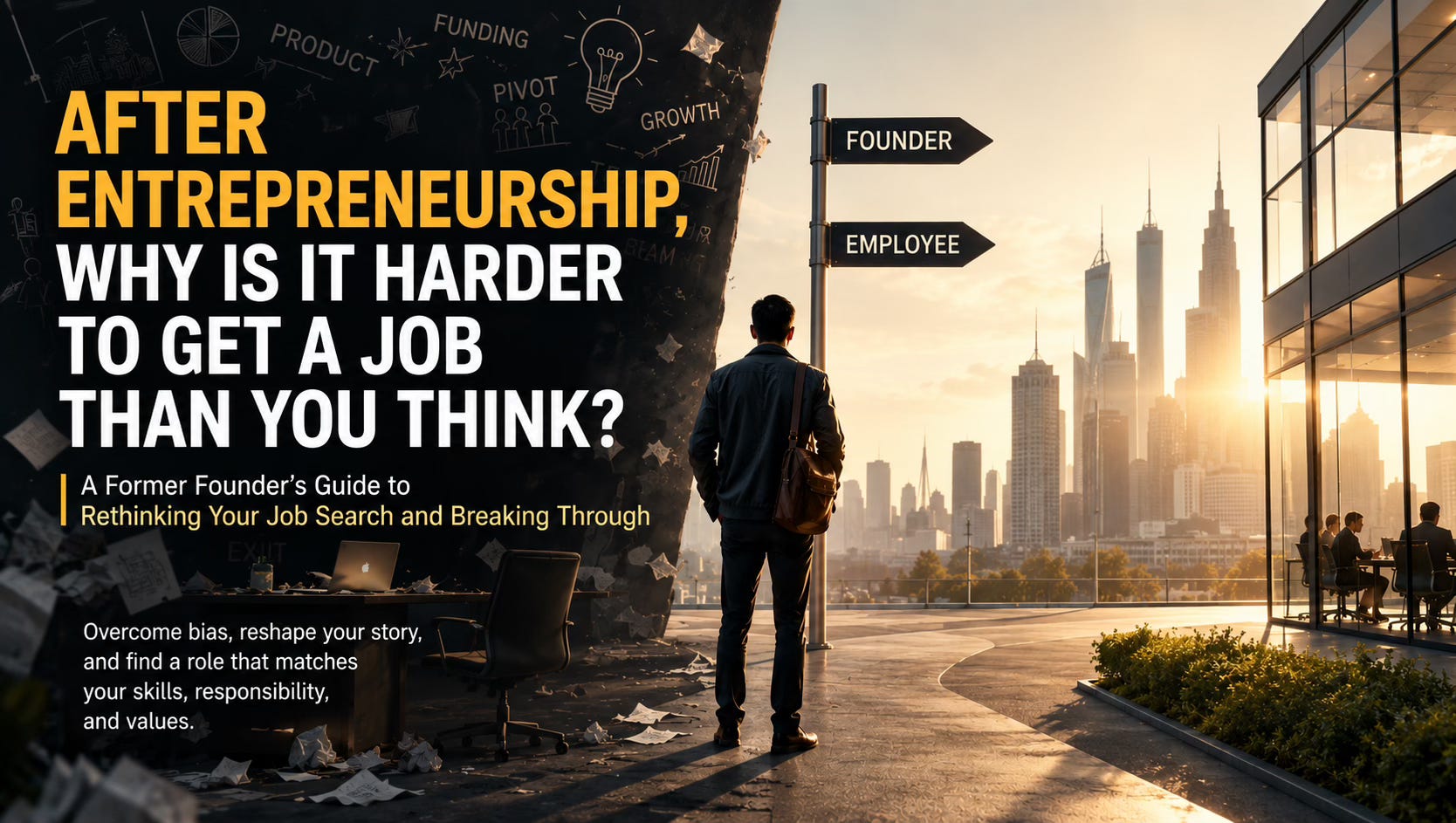
On August 25, 2025, the English edition of The Complete Guide for Former Founders: Overcoming Bias and Landing Your Dream Job was published.
Shortly after the book went live, I joined Spirit AI as Head of Product. I went from being a founder back to being an individual contributor within a larger organization. That transition wasn’t simply a change of title—it meant learning, once again, how to create value inside a system that I didn’t own.
During my time there, I helped define several core products in embodied AI. Later, family responsibilities brought me back from Beijing. Taking care of my father wasn’t an interruption to my career; it was part of my life. Today, with those responsibilities largely behind me and Spirit AI reaching a valuation of nearly RMB 20 billion, I’m grateful that I was able to contribute to an important chapter of its journey.
Over the following months, most of my energy went toward my family, especially my child. As a result, the Traditional Chinese edition of my book sat unfinished. Only recently, after deciding to step away from another embodied AI venture I had been involved with, did I finally find the time to complete the manuscript.
This isn’t a book about writing better résumés.
It’s about answering a much deeper question:
Why does someone who has hired employees, raised capital, built products, managed cash flow, and led organizations suddenly become a “high-risk candidate” when applying for a traditional job?
Companies Want Entrepreneurial Thinking—Until They Meet an Entrepreneur
Browse almost any corporate careers page and you’ll find the same phrases:
Ownership mindset.
Innovative thinking.
Ability to thrive in uncertainty.
Ironically, those are precisely the qualities entrepreneurship develops.
Yet when a résumé arrives with titles like Founder, CEO, or Co-Founder, those same strengths are often translated into liabilities.
Ownership becomes “hard to manage.”
Independent decision-making becomes “unlikely to follow direction.”
Risk tolerance becomes “unstable.”
Cross-functional experience becomes “a generalist without deep expertise.”
Even entrepreneurial success can trigger suspicion:
“If they built a company, why would they want to work here?”
This isn’t simply anecdotal.
Researchers from Yale University and the University of Southern California conducted a field experiment by submitting matched résumés to more than 2,400 software engineering positions across the United States. The only meaningful difference was that some candidates had founder experience. Those applicants received significantly fewer callbacks, and surprisingly, founders with successful exits were penalized even more than those whose startups had failed.
Another study involving 219 experienced corporate recruiters reached a similar conclusion. Candidates with entrepreneurial backgrounds were consistently rated as less attractive for corporate positions despite having equivalent qualifications.
Researchers have since given this phenomenon a name:
The Entrepreneurship Penalty.
Markets celebrate entrepreneurs for creating companies.
Organizations often struggle to imagine where those same entrepreneurs fit inside one.
The Real Concern Isn’t Competence—It’s Predictability
Most founders assume their biggest obstacles are age, changing industries, or technical skills.
Those factors certainly matter.
But there’s another concern that rarely gets discussed:
Companies struggle to predict how former founders will behave.
Hiring isn’t only about buying capability.
It’s about buying reliability, organizational fit, and role clarity.
Managers need confidence that someone can succeed within defined reporting structures, compensation systems, and decision boundaries.
Former founders naturally challenge those assumptions.
They’ve made strategic decisions.
Controlled budgets.
Built teams.
Ignored unnecessary bureaucracy.
Created solutions where none existed.
Inside a startup, those behaviors are assets.
Inside a mature organization, they can be interpreted as governance risks.
The questions running through a hiring manager’s mind are rarely:
“Can this person do the job?”
Instead, they’re asking:
Can they work under someone else’s final decision?
Will they leave in six months to start another company?
Will this role feel too small for them?
Are they willing to handle work that isn’t glamorous but still essential?
Will their salary expectations fit within our compensation structure?
These concerns aren’t entirely irrational.
Research from the University at Buffalo suggests that former entrepreneurs are indeed more likely to leave organizations—but only under certain conditions.
The strongest predictor isn’t entrepreneurial experience itself.
It’s whether individuals continue defining themselves exclusively as founders.
When companies provide meaningful autonomy, creative problem-solving opportunities, and ownership over important initiatives, former entrepreneurs are far more likely to stay.
In other words:
Former founders aren’t difficult to manage. They’re difficult to retain in jobs where judgment isn’t valued and initiative isn’t welcomed.
Returning to Employment Isn’t a Step Back—It’s a Different Choice
I spent twelve years working for multinational companies before founding startups across China and the United States beginning in 2018.
Some ventures failed.
Some exited successfully.
In late 2024, after selling my final AI startup, DeepFashion, I deliberately stepped away to rebuild my health, refocus on my family, and reconsider what I wanted from the next stage of my career.
Since then, I’ve applied for opportunities across North America, Europe, and Asia.
Some employers rejected me.
Some offers I turned down myself.
Throughout that process, I realized something unexpected.
The hardest part wasn’t convincing employers.
It was learning to redefine myself.
Many founders say they’re ready to return to corporate life.
Yet every story they tell still revolves around proving they were once bigger than the role they’re applying for.
They emphasize fundraising.
Valuations.
Press coverage.
Team size.
But they never answer the question employers actually care about:
Why this organization?
Why this role?
What responsibility do you genuinely want to own?
Companies aren’t hiring a miniature CEO.
They’re hiring someone who can produce meaningful results inside an existing system.
That means former founders need to translate their experience.
Instead of saying:
“I built a company.”
Explain:
“I solved complex customer problems.”
Instead of highlighting authority, demonstrate accountability.
Instead of leading with titles, lead with outcomes.
Landing a corporate role doesn’t require abandoning your founder identity. It requires proving that your value extends beyond the title of Founder.
The Rarest Talent Isn’t Experience—It’s Perspective
From a company’s perspective, avoiding former founders feels like prudent risk management.
Yet doing so may cause organizations to overlook one of the rarest types of professionals in today’s economy:
People who have experienced the entire business lifecycle.
Most executives own only one section of the value chain.
Founders have usually lived through all of it.
They know why outstanding products fail commercially.
Why a single hiring mistake can reshape company culture.
Why revenue growth doesn’t always translate into healthy cash flow.
Why strategies that look brilliant in boardrooms often collapse in front of customers.
Failure doesn’t automatically produce wisdom.
Only reflected failure becomes judgment.
Likewise, entrepreneurial experience doesn’t automatically create great employees.
Only founders who consciously redefine their identity can transform entrepreneurial scars into organizational assets.
This is ultimately a two-sided decision.
Former founders must demonstrate that they’re joining an organization—not merely waiting for the next opportunity to leave.
Companies, meanwhile, must decide whether they’re looking at an oversized ego—or a professional whose judgment has already been tested by the market.
Careers Are Not Meant to Move in Only One Direction
We often imagine careers as a straight line.
Larger titles.
Larger teams.
More authority.
Reality rarely works that way.
Some of the most important decisions in my life weren’t about climbing higher.
They were about becoming clearer.
Leaving Beijing to care for my family.
Spending time with my child.
Walking away from projects that no longer aligned with my convictions.
Finally finishing a book I’d postponed for months.
Those choices didn’t make my résumé look more impressive.
They made my priorities more honest.
Entrepreneurship taught me how to build companies.
It also taught me when to stop.
When to walk away.
When to let go of an identity that had served its purpose.
Returning to employment isn’t the opposite of entrepreneurship.
For many founders, it’s simply another deliberate entrepreneurial decision—one that trades total ownership for deeper focus, broader collaboration, and a more sustainable way of creating value.
The end of a startup isn’t necessarily the end of a career.
Sometimes, it’s the beginning of a wiser one.
About the Book
The Complete Guide for
Former Founders: Overcoming Bias and Landing Your Dream Job
is based on both my personal journey and extensive research into what scholars now call the entrepreneurship penalty.
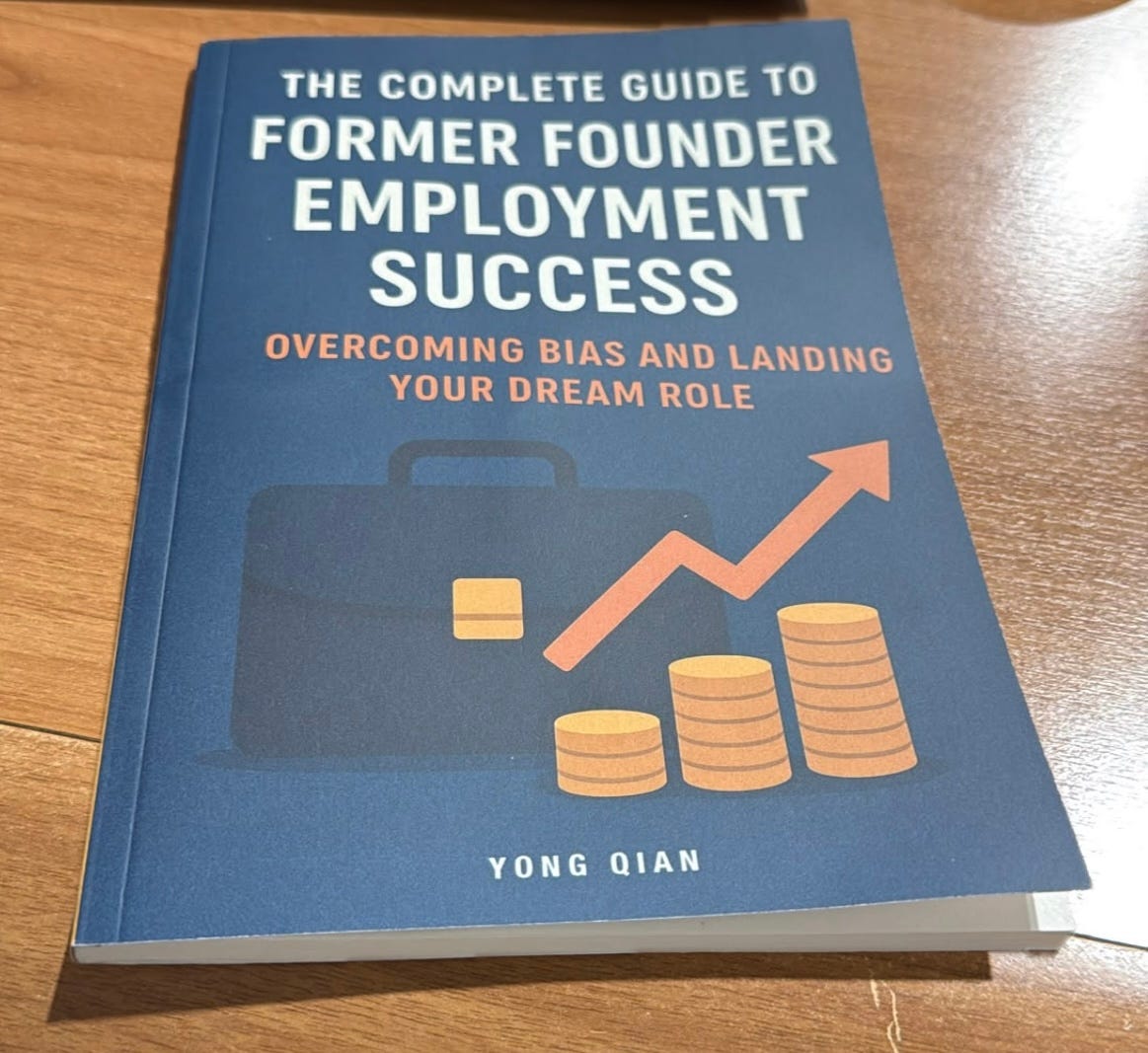
It is written for founders navigating one of the least discussed career transitions in today’s labor market.
You don’t have to deny your entrepreneurial past.
Nor do you need to remain trapped by it.
Your next chapter begins the moment you learn to tell a different story—one that demonstrates not only what you’ve built, but also the judgment, resilience, and perspective you’ve earned along the way.