Schulung & RoboticsFAQ: Two Free Communities — The Most Underrated Chapter in My Hard Tech Arc
Published:
Originally published on Substack.
Yong’s Field Memo | June 2026For hard tech founders, GPs/LPs, and anyone still debugging a line at 2 a.m.
In March I posted a timeline on X of everything I’ve shipped over twenty years — a China robotics blog, BMW/Tesla line systems, JIEQI, OmniEdge, DeepFashion, product work at Spirit AI, the elder-care robot concept AroOne https://77.tech
, then OmniNervous and https://OpenKoi.ai. Long list. Most people stop scrolling halfway through.
When I re-read it myself, I skip two entries too:
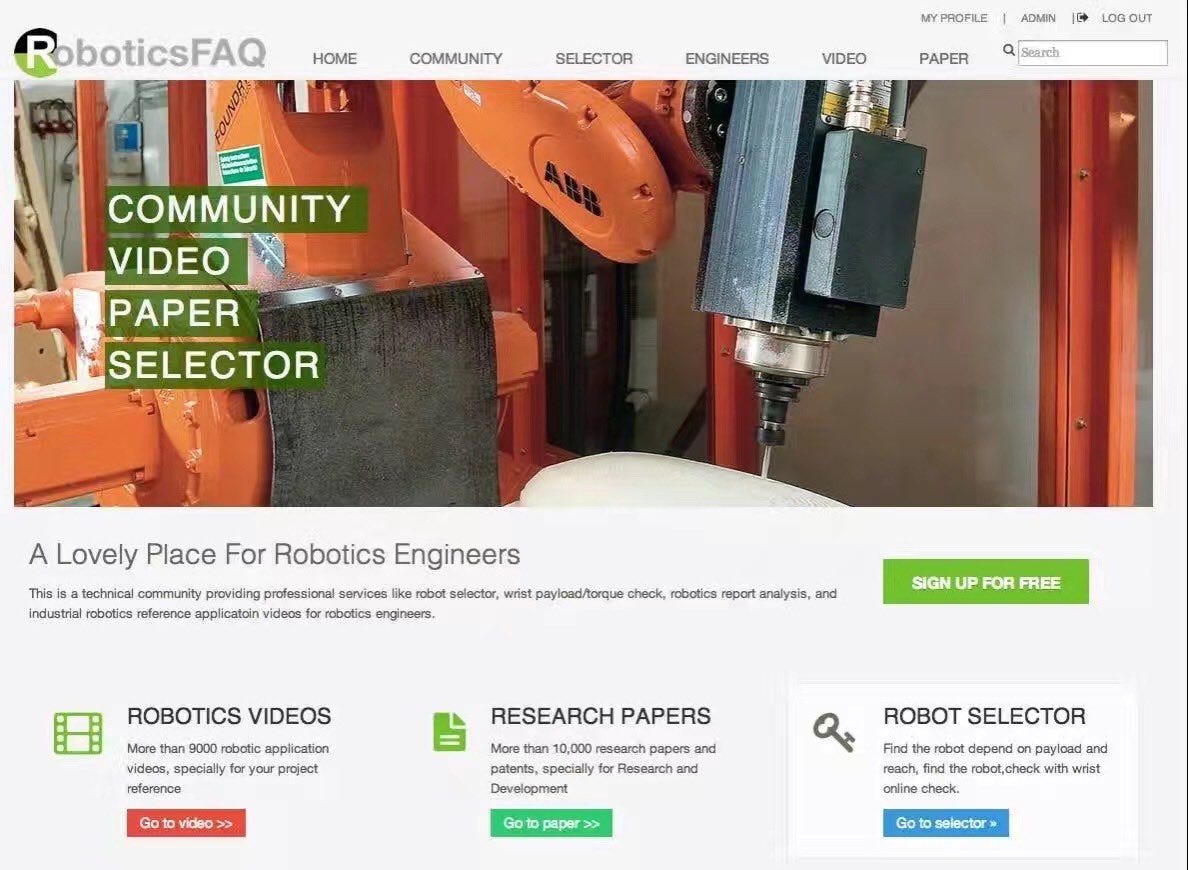
RoboticsFAQ (2012–2016) — a non-profit robotics Q&A community
Schulung / 诩阆 (2015–2017) — a free engineer training MOOC
No ARR. No valuation. No Demo Day screenshots. On qianyong.me they sit in the Non-Profit Projects section — just a domain and a date range.
But if you read backward like an investor — or like a founder still asking where does the first production order actually come from — these two projects carry a signal that’s still worth money today:
In hard tech, the earliest PMF often doesn’t show up in a contract. It shows up when peers keep coming back with the same field question.
2012 vs. 2026: Same industry, different universe
In 2026, more than 150 entities in China claim to be building embodied AI or humanoids. Funding activity in the first half alone is back near historical peaks. Every few weeks a new demo drops — backflips, tea pouring, warehouse runs.
2012 was a different density. No one said “embodied AI.” No one debated VLAs. Capital wasn’t really in the room. The scarce asset wasn’t an algorithm or a demo — it was an engineer who could keep a production line running.
Those years I was bouncing between factory floors globally. Days: coordinating process, sensors, cameras, PLC–robot handshakes. Nights: hotel room, forums, the same threads resurfacing every few weeks:
Critical paragraphs in English manuals no one on the integrator side could parse;
Alarm codes senior techs could work around, but no searchable write-up existed;
Junior engineers who wanted structured training — courses were either expensive or useless on a real line.
My read at the time was blunt: what blocked people wasn’t usually a missing technology. It was not knowing anyone who’d seen that exact failure mode before. Information asymmetry doesn’t stay abstract — it becomes schedule slip, rework, and hidden labor burn. Founders who’ve done integration and investors who’ve run DD both know that math.
That’s how RoboticsFAQ started. Q&A, papers, application videos — ask, answer, archive, search.
RoboticsFAQ: A pre-revenue demand database
Stack RoboticsFAQ against today’s paid communities, knowledge planets, or startup “developer ecosystems” and it looks primitive. No recommendation engine. No live commerce. No fundraising narrative.
What it had — and what a lot of hard tech still lacks — is this: questions from the field, not from the deck.
Active threads were narrow and ugly:
Intermittent e-stop on a six-axis — which log patterns usually point to which root causes?
Vision calibration drifting under line vibration — mechanical first or exposure first?
Multi-vendor PLC talking to a robot — which gateway is cheaper to maintain long-term?
No single right answer. But reproducible debug paths. Leave the path in the thread; the next person picks up where you left off.
If I were an LP diligencing early hard tech, I’d separate two kinds of “community”:
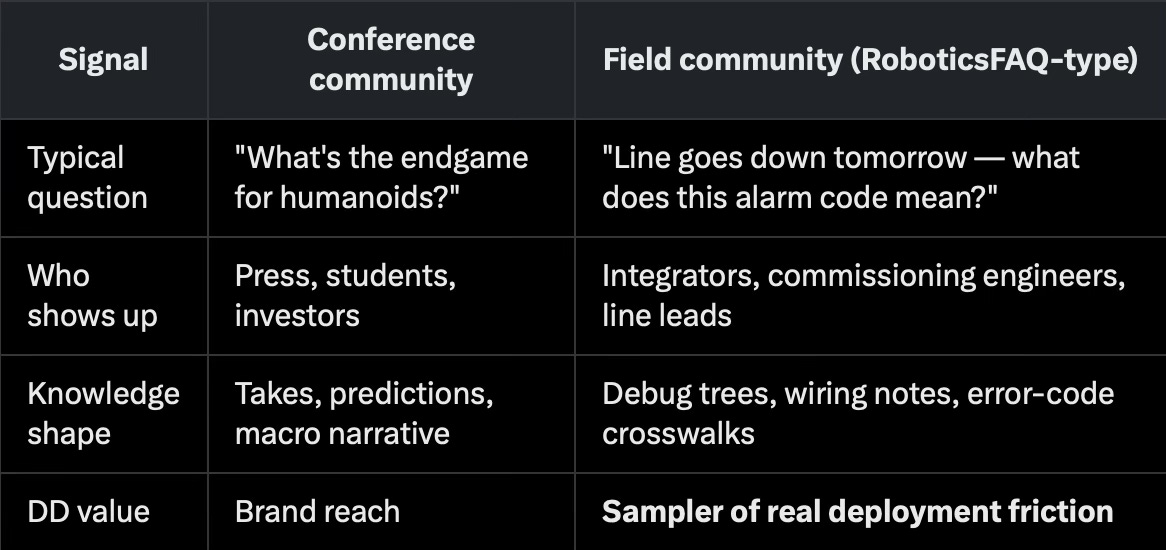
Q&A is horizontal, not vertical. The asker might have two years on the job; the responder might have ten on the floor. Bad answers get corrected in-thread. That error-correction loop is closer to how plants actually work than any one-way training program.
From 2012 to 2016 I never tried to monetize it. Servers were cheap. I covered dev costs myself. Content came from peers. No sales org. Charging would have filtered out exactly the users I knew best — small integrators, new engineers, maintenance crews in second- and third-tier cities.
Schulung: When point fixes aren’t enough
RoboticsFAQ handled spot failures. By ~2015 I kept seeing a different gap: finding one alarm-code fix wasn’t enough. People didn’t know what to learn next.
A junior could follow an existing program. They were still a long way from designing a full robot system. Integrator owners could hire — but couldn’t tell whether someone was missing PLC depth, vision, robot dynamics, or the ability to own the whole stack.
So I built Schulung (诩阆):
Chinese name: 诩阆
English name: Schulung
Domain:
Format: engineer training MOOC
Timeline: 2015–2017 (I launched operations in 2016)
Also free.
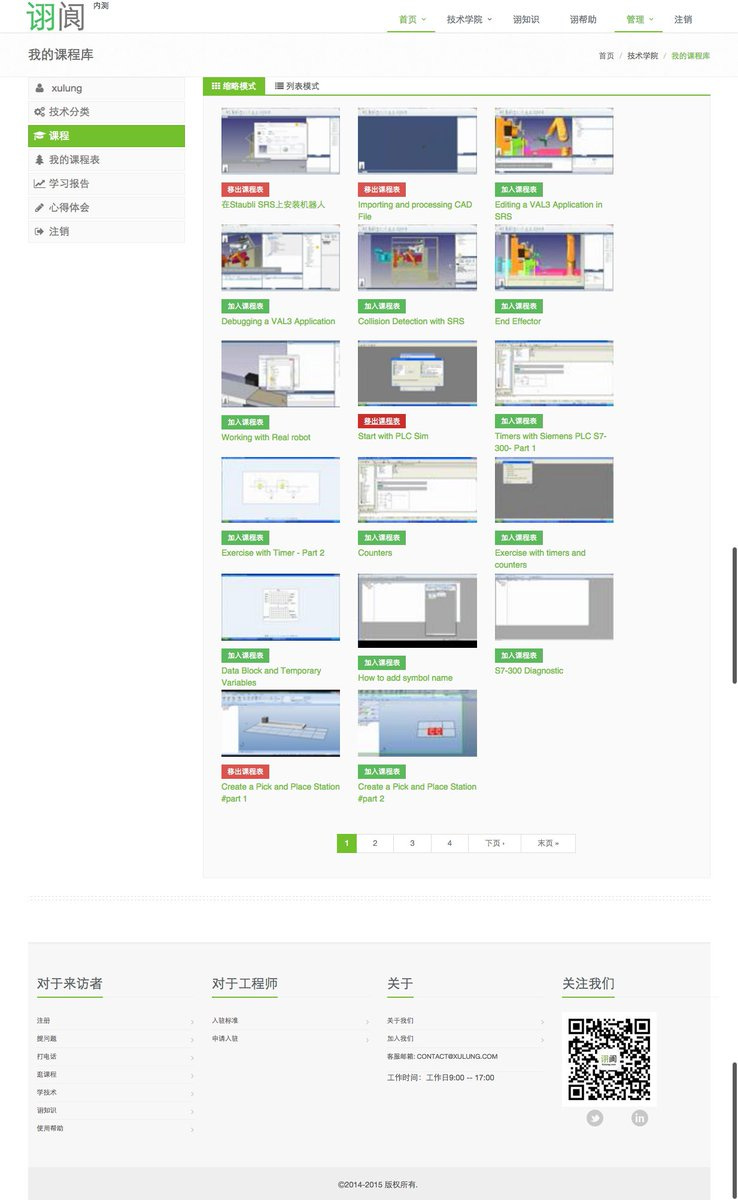
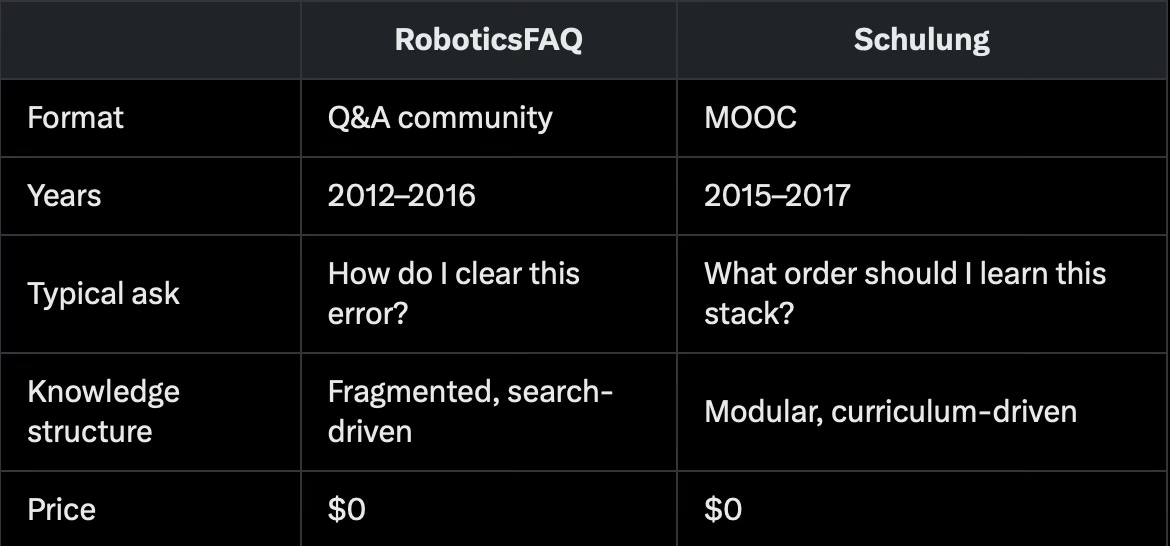
Crude analogy: RoboticsFAQ was a field triage manual. Schulung was an onboarding syllabus.
MOOCs weren’t new. The hard part in industrial automation was the gap between lab curriculum and line reality — grease, takt time, heterogeneous equipment. Schulung tried to fill that gap: how to read safety interlocks, offline programming vs. teach pendant workflow, PLC handshake timing, when to call the OEM vs. when to grep the logs yourself.
Not sexy. Very usable for integrator teams outside tier-one cities — closer to shipment than a keynote on “the next decade of humanoids.”
For founders the through-line is obvious: community tells you where users get stuck; curriculum tells you where talent is thin. Stack both and you’re approaching scalable delivery — not just a moving demo.
One timeline, not two careers
2004 China robotics blog
2006 Weibo robotics channel (于仁颇黎@机器人)
2012 RoboticsFAQ (Q&A community)
2015 Schulung (training MOOC)
2008+ Industrial robot systems (wafer handling, laser cutting, BMW/Tesla auto lines)
2018 JIEQI (industrial IoT)
2021 OmniEdge (enterprise mesh VPN — 7,000+ users across 26 countries)
2023 DeepFashion (fashion design AIGC)
2025 Spirit AI product work / AroOne / OmniNervous / OpenKoi
Community work and commercial products overlapped. Not chapter one charity, chapter two startup.
RoboticsFAQ and Schulung kept me inside real engineer questions for years — which issues resurfaced every few weeks, which topics paid courses skipped, which traps were documented in English but never translated for the Chinese field context. Later, building JIEQI and OmniEdge, the same needs kept reappearing in the roadmap: remote troubleshooting, connect gear across geographies, reduce friction to get the right answer fast. OmniNervous rewrote the P2P layer in Rust for AI and industrial fleets — different stack, same obsession I picked up in those two communities:
Field knowledge shouldn’t be hostage to geography.
In one line:
RoboticsFAQ / Schulung → JIEQI → OmniEdgeTransport went from forum threads and screen-recorded lessons to mesh VPN. The problem didn’t: machine in city A, expert in city B, line can’t wait.
For investors, that arc matters more than “founder did philanthropy.” It shows product instinct can run a user loop at zero revenue, then migrate to billable infrastructure. In hard tech DD, that’s a more believable pattern than “raise first, build community later.”
If I were an LP: three signals I’d still underwrite
RoboticsFAQ and Schulung never hit ARR or a cap table. But they left fingerprints I still use in diligence — not slide-deck methodology, field observations:
Signal 1: User insight before monetization.
What got searched and re-asked often became feature priority later — not from a competitive matrix, but from questions already asked a hundred times in the forum.
Founder read-through: if a hard tech team’s principals have never lived inside their own user community — GitHub issues, Discord, integrator WeChat groups — I’d question whether they actually know where deployment breaks. Demos can be outsourced. Debug paths can’t.
Signal 2: “Can ship” ≠ “can teach.”
Schulung forced me to modularize a decade of field work. Doing the job and diagnosing where someone else stalls are different skills. The second one sets hiring velocity, support cost, and retention.
Investor read-through: I’ve seen teams with gorgeous algorithm metrics in the deck and empty training docs, delivery SOPs, and integrator enablement. Their ramp usually runs 1–2× slower than the financial model assumes.
Signal 3: Free community ROI isn’t ARR — it’s trust inventory and talent pipe.
Servers, dev, course production, moderation, spam removal — all real cost. The return: peers remember you showed up when it wasn’t a product pitch. Later, when you ship OmniEdge, publish a field memo, or make an investment call, they listen past the first sentence.
Founder read-through: early hard tech is rarely short on Twitter followers. It’s short on the first integrators and field engineers willing to test when you’re still unreliable. Community is one of the cheapest ways to recruit that cohort — not the only way, one of the most underpriced.
2026: Capital is loud. The help thread is still the same.
Robotics today has orders of magnitude more capital than 2012. Humanoid demos reset expectations every few weeks. Government guidance funds are everywhere.
I still think about RoboticsFAQ’s plain thread titles and Schulung’s unglamorous slides.
Back then there was no embodied AI label, no VLA discourse, no humanoid valuation comps. One scene on repeat: machine down, line lead waiting, engineer posting, hoping someone who’s seen that floor before replies.
One thing hasn’t changed — and it’s still one of the most expensive mistakes in the category:
The gap between lab Sim and line Real isn’t just algorithms. It’s who has read the English manual and who has cleared that e-stop pattern before.
If you’re underwriting embodied AI in 2026 and you only track demo reels and round sizes — not deployment friction, integrator enablement, or how field knowledge compounds and transfers — you’re probably missing the layer RoboticsFAQ and Schulung lived in every day.
Those two projects were my answer to that layer when I was younger. Free not because they weren’t valuable — because the person on the line usually had no time and no budget for a ticket in.
About the author
Yong (涌) — 20-year industrial automation and robotics operator; three exits across IIoT, AIGC, and OSS in the US and China. Former Head of Products at Spirit AI.