
The Invisible Nervous System: Shipping OmniEdge 1.0 at the Speed of Thought
Published:
Originally published on Substack.
In the history of software development, we have long been governed by the "Man-Month"—the idea that complex systems require vast teams and predictable, often grueling, timelines. But over the past few days, a quiet revolution occurred at OmniEdge that suggests the old math is dead.
By rebuilding the entire stack—from the backend in Go to desktop GUIs in Wails and mobile apps in Swift and Kotlin—the team didn't just ship a product; they demonstrated a new physics of production. In just five days, 800,000 lines of code were refactored, nine repositories were modernized, and a cross-platform 1.0 was delivered to production.
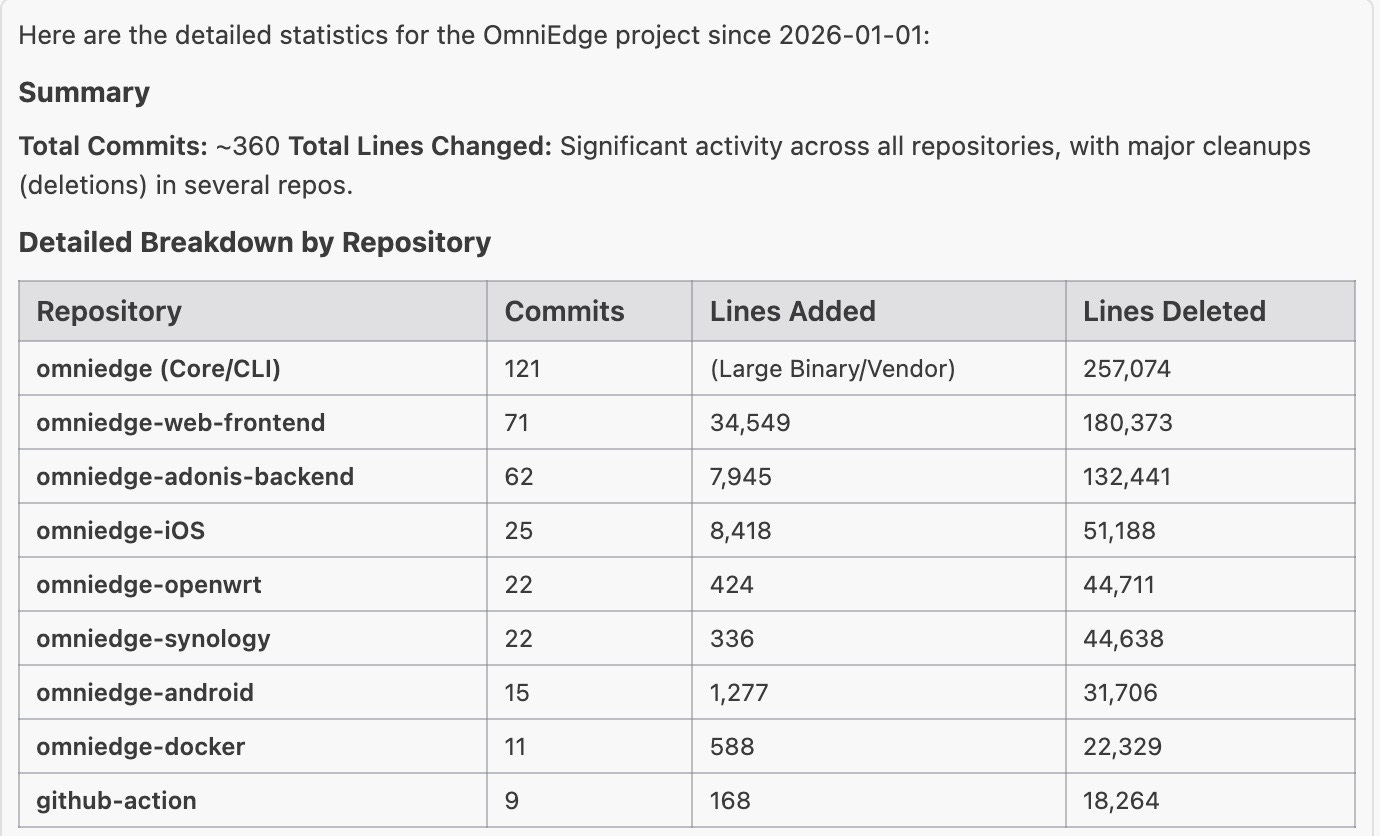
This is the era of the Compressed Cycle.
Part 1: Software at the Speed of Thought
The transition from "Man-Months" to "Model-Hours" is the single most significant shift in entrepreneurship today. When a developer can use AI—tools like Claude, xAI, and Antigravity—to drive a PRD end-to-end across Windows, macOS, iOS, and Linux in a single work week, the "schlep" of development evaporates.
For the modern founder, this means the distance between Idea → System → Production has collapsed. We are no longer building software; we are orchestrating it. This speed allows for a level of experimentation that was previously cost-prohibitive.
Furthermore, we are entering a decade where the most successful companies will be "AI-native." These organizations won't be defined by bloated IT departments, but by autonomous agents and distributed nodes. OmniEdge is building the Invisible Nervous System for these entities. By providing secure, peer-to-peer connectivity that is "driverless" and "zero-config," they have removed the final friction point of the decentralized office. Infrastructure is finally becoming what it always should have been: an afterthought.
Part 2: The Recursive Fabric — How OmniEdge Powers the AI Era
As AI begins to enhance the very tools used to build it, we enter a recursive loop of innovation. OmniEdge sits at the center of this loop, providing the connectivity fabric that allows "AI enhanced by AI" to scale.
• The Distributed GPU Fabric: AI training is no longer confined to single data centers. With OmniEdge, disparate GPUs across different regions and architectures see each other as if they are on a local LAN. It provides the low-latency, encrypted pipe needed for parameter synchronization without the overhead of traditional VPNs.
• The Edge-to-Brain Link: As AI moves into the physical world—humanoids, industrial robots, and IoT sensors—the connectivity must be instantaneous and secure. OmniEdge’s support for RISC-V and its "Zero Firewall" configuration means an AI agent can be deployed to a remote sensor and maintain a secure heartbeat back to its central model without ever exposing the device to the public internet.
• AI-Powered DevOps: Because OmniEdge is built with a robust Admin API and a CLI-first philosophy, the network itself becomes programmable by AI. If an autonomous agent detects a data surge, it can use the OmniEdge API to spin up a new virtual isolation network or re-route traffic without human intervention.
• Data Fluidity over Data Gravity: AI is data-hungry. By utilizing Peer-to-Peer (P2P) encryption, OmniEdge avoids the "central hub" bottleneck. Data moves directly from the source to the model, ensuring that the next generation of AI isn't throttled by 1990s-era networking architecture.
The Conclusion
OmniEdge 1.0 is more than a release; it is a proof of concept for the future of work. By using AI to build the very infrastructure that AI requires to thrive, the team has closed the loop. For programmers, managers, and investors, the message is clear: The tools for the autonomous economy are no longer on the horizon. They are here, they are secure, and they are production-ready.