
The Foolish Old Man’s Mountains Are Actually The Bias In The Human Heart
Published:
Originally published on Substack.
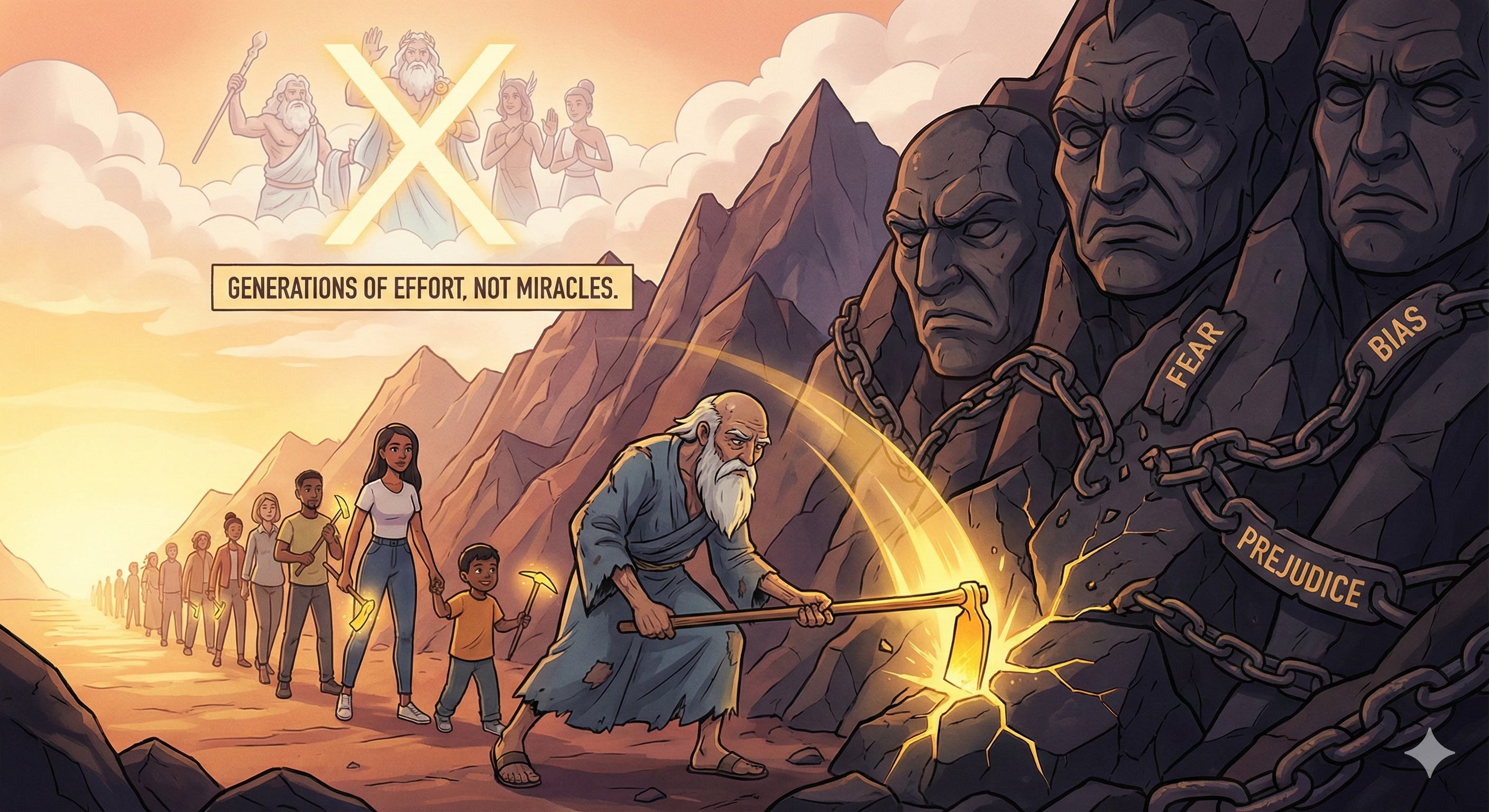
In the fable of The Foolish Old Man(Yugong) Removes the Mountains, what is truly being shifted is the “bias”—that colossal mountain entrenched in the human heart. It demands relentless effort from generation after generation, without pause, and only immortals (impossible, mythical beings like the gods in the story) could whisk it away in a single stroke, much like how the God’s divine intervention resolved Yugong’s earthly toil.
Bias looms like those ancient peaks of Taihang and Wangwu mountains, obstructing clear vision and hindering forward progress, just as they forced Yugong’s family into endless detours. It manifests as racial biases, rigid gender stereotypes, or an irrational fear of the unfamiliar and innovative. These barriers aren’t erected in a day; they accumulate over lifetimes, rooted in cultural norms, personal experiences, and societal conditioning, making them as unyielding as the mountains that seemed eternal to Yugong’s critics.
Yugong’s humble hoe symbolizes tools like education, open dialogues, and introspective self-examination—simple yet persistent actions that chip away at the rock. But as Yugong himself acknowledged, a single lifetime’s digging might only dislodge a tiny fragment, echoing his vow that his descendants would continue the work indefinitely, turning individual resolve into a familial legacy.
Social advancement mirrors this cross-generational saga; it’s rarely swift but unfolds over eras, much like how Yugong’s determination spanned beyond his own mortality. Consider Martin Luther King’s dream of equality, articulated in his “I Have a Dream” speech—a vision that, like Yugong’s path-clearing, inspires ongoing efforts today, from civil rights movements to global fights against discrimination, where each generation builds on the last.
In our real world, there’s no enchanted button to eradicate bias instantly, no simple reboot for human nature as if we were machines. Unlike the fable’s miraculous godly aid, which represents an unattainable shortcut, bias is woven into our instincts—evolutionary remnants of tribalism and survival mechanisms. It requires the same steadfast “mountain-moving” spirit: daily acts of empathy, policy reforms, and cultural shifts, persisting even when progress feels glacial, until the landscape of minds is forever altered.