
Embodied AI The Next Global Industrial Race[Slides]
Published:
Originally published on Substack.
Embodied AI is now emerging as the next global battleground — on a scale rivalling the historic Space Race, the semiconductor wars, defense–aerospace rivalries, and the automotive‑energy transformation. Its eventual winners will shape not just market leadership, but national power, technological ecosystems, and global industrial orders for decades ahead.
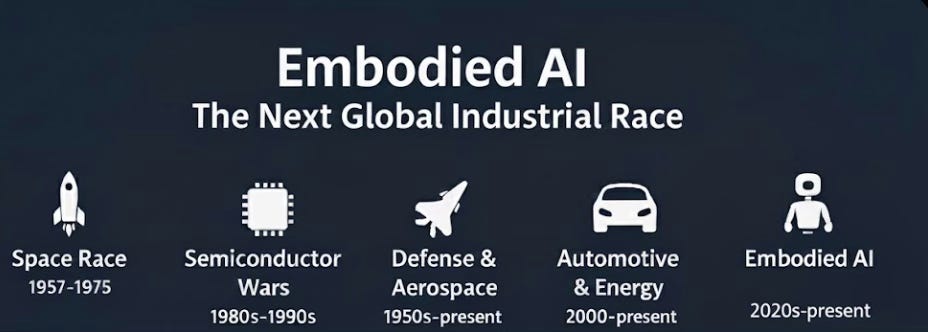
What History Teaches Us: Past Industrial Battles
The Space Race (1957–1975):
After the 1957 launch of Sputnik, the U.S. and the Soviet Union embarked on a decades‑long contest for space supremacy. The U.S. alone spent about US$25.8 billion on the core Project Apollo (1960–1973) — or roughly US$257 billion in 2020 dollars.
Including related programs (Project Gemini, robotic lunar probes), total spending reaches about US$28 billion at the time, or nearly US$280 billion in equivalent modern dollars.
Hundreds of companies and government labs (launch‑vehicle builders, spacecraft manufacturers, instrumentation and ground‑station contractors) participated. Every technical advantage — from navigation to life support — had geopolitical consequences. The result: six moon landings, mastery of spaceflight, and a legacy of aerospace/engineering infrastructure.
The Semiconductor Wars (1980s–1990s):
During this period, global competition over memory chips (especially DRAM) and microprocessors intensified. The battle pitted U.S. firms like Intel, AMD, and others against Japanese firms (e.g. Toshiba, NEC, Hitachi) which ultimately captured a dominant share of global DRAM supply.
The shift happened despite high capital intensity: massive investment in clean‑room fabs, R&D, process engineering. Over time, many U.S. firms exited DRAM, illustrating how failure to sustain investment and integrate supply ecosystems can lead to rapid collapse, even for leading players.
Defense & Aerospace Competition (1950s–present):
Beyond space exploration, global competition has raged over aircraft, missiles, jets, and defense systems. Major players — both state‑backed and private (e.g. Lockheed Martin, Boeing, European and Soviet/Russian manufacturers) — have poured billions to tens (even hundreds) of billions of dollars into developing cutting‑edge airframes, propulsion, electronics, and support systems. Success depends not on just a single platform, but on entire integrated supply chains, maintenance systems, and geopolitical alliances.
Automotive & Energy Revolution (2000s–present):
With climate pressures, regulation, and advances in battery technology, the automotive sector has undergone a seismic shift. Traditional automakers and newcomers (e.g. Tesla, BYD) compete not just on vehicles but on battery chemistry, charging infrastructure, software, and supply‑chain dominance. This transformation involves capital investments in factories, energy supply, software platforms, and logistics networks across the value chain — turning what once was hardware competition into ecosystem competition.
These historical episodes share a pattern: high capital intensity, deep technical and organizational complexity, long timelines, and ultimately — winners that control entire ecosystems rather than just single products.
Embodied AI: Why It Mirrors (and Extends) These Battles
Embodied AI inherits the structural traits of those historic competitions — and layers in new complexities:
It demands deep hardware‑software integration: robotics, sensors/perception, control systems, cloud infrastructure — all need to work seamlessly.
It depends on real‑world deployment and continuous data feedback loops: robots must operate in unpredictable environments; every deployment generates data that feeds future improvements.
The competitive landscape is already broad: dozens (even hundreds) of startups, legacy robotics firms, cloud‑AI companies, and national labs participate globally. According to a recent report, the global embodied AI market is expected to grow from about US$4.44 billion in 2025 to US$23.06 billion by 2030 (CAGR ~39%).
Cost per system is substantial: building and deploying a high‑functionality humanoid or autonomous robot platform — including R&D, hardware, software, and integration — can easily run into tens of millions of dollars. Scaling across production, maintenance, software updates, and services raises that significantly.
This is not a product‑by‑product race. It’s a resources‑, ecosystem‑, and deployment‑driven war — similar in structure to the Space Race or semiconductor wars, but now played out in robotics + AI + real‑world automation.
Three Lessons from History — Now Vital for Embodied AI
1. Long‑term investment determines success.
Historical winners like those in aerospace or semiconductors committed years — often decades — to R&D, infrastructure, and scaling. For Embodied AI, only organizations (or coalitions) able to sustain high capital and talent investment over long cycles will dominate.
2. Ecosystems matter more than single innovations.
In previous industrial battles, firms that controlled supply chains, manufacturing, ancillary infrastructure, and complementary technologies captured dominant positions — not those with just one “killer product.” In Embodied AI, advantage will lie with those who master data pipelines, hardware production, software tooling, integration, deployment, maintenance, and continuous improvement.
3. Policy, standards, and regulation shape the battlefield.
Space Race, defense, semiconductors — all were deeply influenced by national security concerns, trade policy, export controls, and government backing. Embodied AI is no different: safety standards, export regulations, labor laws, data privacy, and industrial policy will all influence who wins — and early participation in shaping such rules may itself be a strategic weapon.
Embodied AI Is More Than Technology — It’s the Next Strategic Industrial Race
Embodied AI is not just a new tech wave — it is a global, ecosystem‑driven competition combining capital intensity, technological complexity, industrial scale, and strategic significance. Much like the Space Race, semiconductor wars, aerospace rivalry, and automotive‑energy shift before it, this is a long time‑horizon battle for supremacy. The corporations, nations, and alliances that succeed will define not only market winners, but the shape of industry, labor, security, and infrastructure for decades to come.
If we treat Embodied AI as a strategic race — as previous generations treated rockets, chips, and cars — we may very well be witnessing the birth of the next Industrial Age.