Understanding the Entrepreneurship Penalty
Published:
Originally published on Substack.
The entrepreneurship penalty represents a systematic bias in corporate hiring practices that significantly disadvantages former startup founders. This phenomenon extends far beyond simple preference differences, representing a fundamental misunderstanding of the value proposition that former entrepreneurs bring to established organizations.
The Statistical Reality
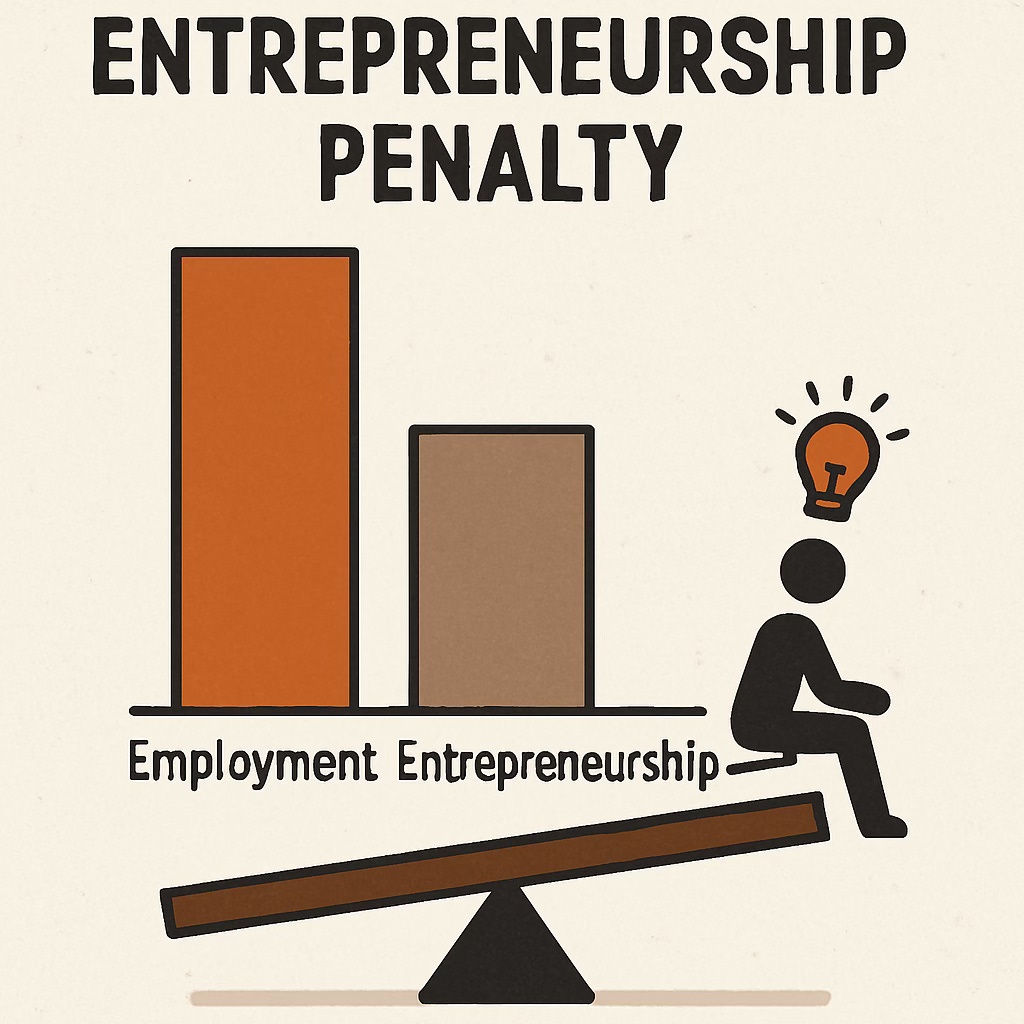
Recent academic research from the London Business School provides stark evidence of this bias. Former entrepreneurs are 35% less likely to receive job interview invitations compared to candidates with traditional corporate backgrounds [1]. This statistic becomes even more troubling when examined through the lens of a comprehensive study conducted by Rutgers University's School of Management and Labor Relations, which found that 60% of recruiters respond less favorably to resumes from former entrepreneurs, even when education and experience levels are comparable .
Perhaps most counterintuitively, research from Harvard Business Review reveals that successful founders face even greater discrimination than those whose startups failed. Software engineering candidates with successful startup experience were 33% less likely to receive job interview offers compared to those whose companies had failed [1]. This paradox suggests that the bias against founders is not rooted in concerns about competence, but rather in deeper psychological and cultural factors within corporate hiring practices.
The scope of this challenge becomes clear when considering the broader startup ecosystem. Analysis of Crunchbase data reveals that only one in three seed-funded startups between 2011 and 2018 successfully raised post-seed funding . This means that a significant portion of the entrepreneurial talent pool—potentially thousands of experienced founders—faces systematic barriers when seeking traditional employment opportunities.
Root Causes of Hiring Manager Hesitation
The reluctance to hire former founders stems from five primary concerns that pervade corporate hiring practices. Understanding these concerns is crucial for developing effective counter-strategies.
1. Autonomy versus Authority Conflicts represent the most frequently cited concern among hiring managers. Corporate leaders worry that founders, accustomed to making unilateral decisions and operating with complete autonomy, will struggle to function within established hierarchical structures. This concern manifests in fears that former founders will "go rogue," bypassing established processes or undermining existing leadership structures. The underlying assumption is that entrepreneurial experience creates individuals who are fundamentally incompatible with collaborative decision-making processes. However, this assumption fails to recognize that successful founders must actually excel at collaborative leadership. Building and scaling a startup requires constant negotiation with investors, board members, customers, and team members. The decision-making autonomy that founders experience is often constrained by resource limitations, market feedback, and stakeholder input. In many cases, founders develop superior skills in consensus-building and stakeholder management precisely because they lack the formal authority structures available in corporate environments.
2. Cultural Fit and Ego Management concerns reflect deeper anxieties about status and hierarchy within corporate environments. Hiring managers worry that former founders will struggle with the perceived "step down" from CEO to employee, potentially creating tension with existing team members or leadership. There's a pervasive belief that entrepreneurial experience creates inflated egos that are incompatible with collaborative team dynamics. This concern often reveals more about corporate culture limitations than founder capabilities. Organizations that view former founder status as threatening may be signaling their own insecurity about innovation and change. Companies that successfully integrate former founders, such as @Rippling and @supabase, demonstrate that the perceived ego issues are often cultural mismatches rather than inherent founder characteristics.
3. Commitment and Retention Anxieties center on the assumption that former founders are inherently unreliable employees who will abandon their roles at the first opportunity to start another venture. This "serial entrepreneur" stereotype suggests that founders are constitutionally incapable of long-term commitment to organizations they don't control. Recent research challenges this assumption by demonstrating that timing plays a crucial role in founder retention patterns. Analysis of over 12,000 wage job experiences in Australia revealed that individuals who transition directly from entrepreneurship to employment are actually less likely to quit to start new businesses compared to those whose current job represents their second post-entrepreneurship role. This finding suggests that the immediate post-startup period may actually represent a window of increased employment stability rather than flight risk.
4. Compensation and Expectation Misalignment reflects concerns about founders' financial expectations and equity demands. Hiring managers worry that former founders will expect compensation packages that reflect their previous CEO status, including significant equity stakes or performance bonuses that exceed standard employee packages. While these concerns have some validity, they often stem from poor communication during the hiring process rather than unrealistic founder expectations. Many former founders are actually seeking stability and predictable compensation after experiencing the financial volatility of startup life. The key lies in establishing clear expectations and demonstrating how the role provides value beyond pure financial compensation.
5. Skill Alignment and Specialization Gaps represent perhaps the most legitimate concern in the entrepreneurship penalty. Founders typically develop broad generalist skills across multiple business functions, while corporate roles often require deep specialization in specific domains. Hiring managers question whether founder experience translates effectively to focused functional roles. This concern highlights a genuine challenge that founders must address proactively. However, it also represents an opportunity for organizations willing to leverage the cross-functional perspective that founders bring. Former founders often excel in roles that require coordination across multiple departments or functions, such as product management, business development, or strategic initiatives.
The Gender Dimension
Research reveals significant gender differences in how the entrepreneurship penalty manifests. The Australian study found that male former founders show decreased entrepreneurial intentions immediately after exiting their startups, making them potentially more stable employees in the short term. Female former founders, however, do not exhibit the same decrease in entrepreneurial intentions, suggesting different psychological responses to startup failure or exit.
These findings have important implications for hiring strategies. Organizations seeking to hire former founders may need to develop gender-specific approaches that account for these different psychological patterns. Female former founders may require different retention strategies or role structures to maximize their long-term commitment and satisfaction.
Industry and Role Variations
The entrepreneurship penalty varies significantly across industries and role types. Technology companies, particularly those in growth stages, tend to be more receptive to former founder candidates. This receptivity stems from cultural alignment with entrepreneurial values and recognition of the technical and business skills that founders develop.
Conversely, traditional industries such as finance, healthcare, and manufacturing often exhibit stronger biases against entrepreneurial backgrounds. These industries may prioritize regulatory compliance, process adherence, and risk management—characteristics that seem antithetical to entrepreneurial approaches.
Role-specific variations also emerge in the data. Former founders tend to face less discrimination when applying for senior leadership positions, where their strategic experience and business acumen are more obviously relevant. However, they face greater challenges when seeking individual contributor roles, where their broad skill set may seem less applicable.
The Innovation Paradox
Perhaps the most ironic aspect of the entrepreneurship penalty is that it occurs precisely when organizations claim to prioritize innovation and agility. Corporate leaders consistently emphasize the need for entrepreneurial thinking, risk-taking, and innovative problem-solving, yet systematically exclude the individuals who have demonstrated these capabilities most clearly.
This paradox suggests that the entrepreneurship penalty may be more about risk aversion and cultural inertia than rational assessment of candidate capabilities. Organizations that overcome this bias gain access to a talent pool with proven innovation capabilities, risk management experience, and strategic thinking skills.
The companies that successfully hire former founders often report significant benefits in terms of innovation, strategic thinking, and cross-functional collaboration. These organizations recognize that the perceived risks of hiring founders are often outweighed by the unique value they bring to established teams and processes.