When Global Sovereign Funds Bet on China’s Tech Out of FOMO, Local Entrepreneurs Are Ditching Their “Executor” Labels
Published:
Originally published on Substack.
01 | The Crossing: A Tipping Point Between Old and New Orders
“Every 6.5 funding rounds now includes a ‘+ round’”—in the first half of 2025, China’s venture capital market recorded 591 such “plus rounds,” creating a striking footprint of the times. In hard tech fields like semiconductors and biotech, funding rounds are sprouting extra plus signs like ivy vines: A+, A++, A+++, even A+++++. This reveals the tug-of-war between tech R&D and capital patience: startups seek to extend survival, while investors adopt a cautious “small steps, quick runs” model to manage risk.
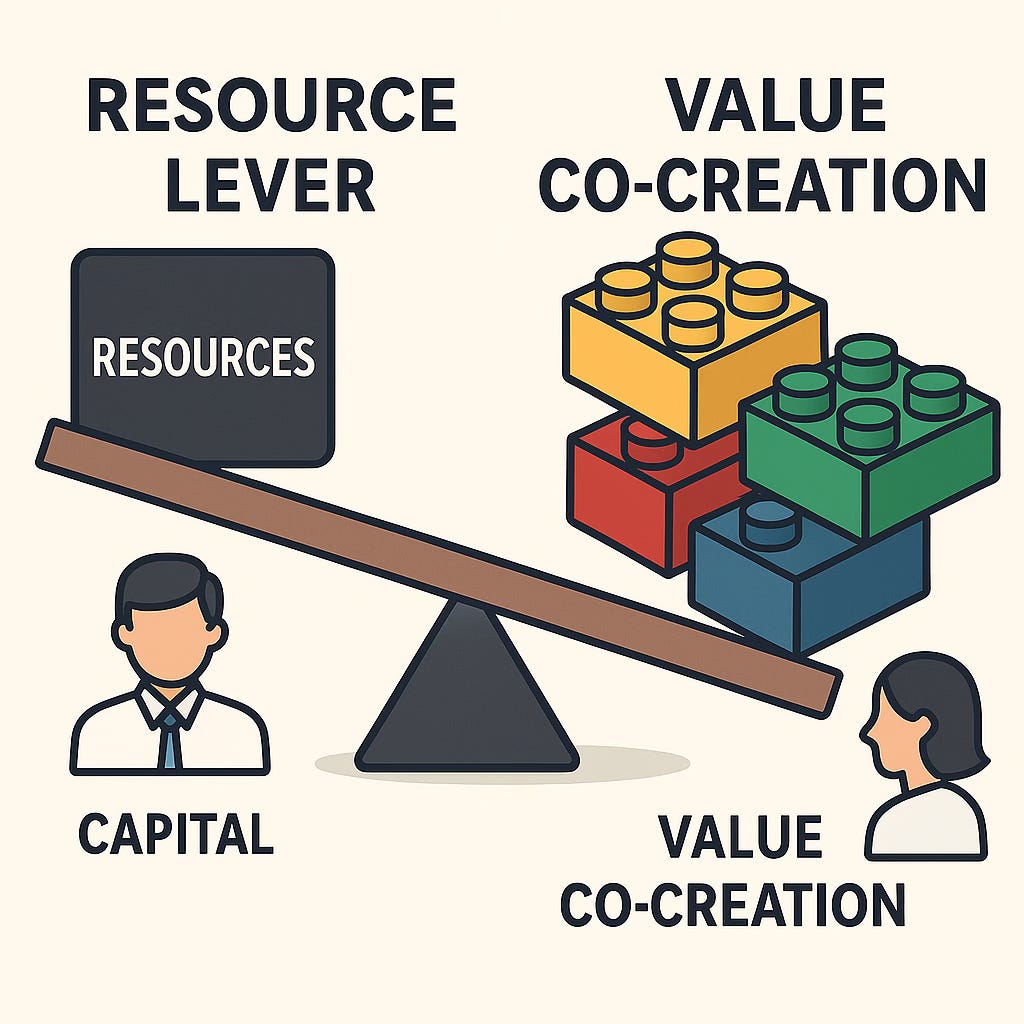
As tech think tank AlphaAge put it, China’s VC ecosystem is at a “crossing”: the old model of resource arbitrage is fading, while a new order based on value symbiosis is accelerating. On one hand, an Invesco report shows global sovereign wealth funds are returning to Chinese tech—59% now rank it as a high-priority investment. On the other, local governments like Wuxi are launching “Invest + Grant 2.0” initiatives to de-risk early-stage tech projects and correct market failures. A quiet revolution is already underway in the tug-of-war between resource leverage and value co-creation.
02 | The Evolution of Resource Leverage: From Harvesting to Planting
Old Paradigm: Concentrated Power, Misaligned Risk
In the early days of China’s VC boom, the “shadow controller” model dominated: resource gatekeepers steered policy-driven industries while young entrepreneurs charged ahead—only to see the lion’s share of returns flow to capital.
Luckin Coffee rode the twin-boom of mass entrepreneurship and innovation to scale rapidly. While founder Qian Zhiya became a startup celebrity, her ownership was heavily diluted by institutional players like Centurium Capital after IPO.
NIO rose with support from state capital and Tencent, but founder William Li faced immense pressure from aggressive performance-based agreements.
This model relied on a triple leverage formula:
Policy arbitrage (e.g., new energy subsidies),
Capital binding (preferred shares and liquidation rights),
Tech outsourcing (R&D teams lacked control).
The result? Homogenized innovation: Luckin cloned Starbucks; NIO benchmarked Tesla. Disruptive originality was rare.
New Shape: Anchored State Capital and Embedded Ecosystems
With hard tech sectors gaining traction, resource leverage is being reengineered:
State capital is emerging as “patient capital”: Government-guided VC funds, through fund-of-funds, direct equity, and co-investment models, have mobilized trillions of yuan into fields like semiconductors and quantum tech.
Localized co-creation is replacing top-down directives: Firms like Yida Capital in Kunshan operate with a 10-person local team, partnering with public platforms to invest in 29 tech ventures. This has drawn corporate HQs to relocate to Kunshan, forming embedded industrial ecosystems.
Invest-Grant hybrids de-risk early-stage innovation: Institutes like Wuxi Industrial Research turn R&D grants into equity, backing startups like Weishi Power, with government funds absorbing early risk and market funds scaling production.
Resource leverage hasn’t vanished—it’s just pivoted from control to co-creation.
03 | Rise of Value Co-Creation: Tech Sovereignty Tips the Power Balance
While old-school power players cling to legacy models, a new generation of entrepreneurs is redrawing the rules—with technological moats as spears and contractual design as shields.
Tech Empowerment: From Pawns to Players
DJI commands 80% of global drone patents and retains full voting control through a dual-class (AB-share) structure. Founder Frank Wang maintains absolute decision-making power.
NIO rewrote its performance agreement with Hefei state capital, shifting from a near-impossible revenue target (¥120B by 2024) to more sustainable R&D and supply-chain impact benchmarks—moving from betting on profit to betting on ecosystem contribution.
In 2025, AI robotics funding in China surpassed ¥23.2B, flowing into foundational infrastructure and embodied intelligence. StarVision Technology raised $100M in an A+++ round thanks to a robust multi-modal perception algorithm—its technical moat sealed the deal.
Capital’s Evolution: From Catchers to Collaborators
VCs themselves are transforming:
Golden Tripod Capital now mandates a “three-dimensional defense” system: AB-share structures, patent pools for control, and value anchors like NIO’s battery-swap patents.
Corporate venture capital (CVC) is squeezing out traditional financial VCs: firms like Huawei and CATL provide orders and R&D support, embedding portfolio startups directly into supply chains.
“VCs are no longer chess players, and founders are no longer pawns,” said Yida’s Huang Tao of the Kunshan model.
“We’re more like LEGO bricks—startups bring the innovation modules, and capital provides the connectors.”
04 | Repricing China: A Global Recalibration of Assets
As Trump-era tariffs shook global trade, Chinese tech became a contrarian bet for sovereign wealth funds. Invesco found that funds managing $27 trillion are now calling China “the next Silicon Valley.” North American funds in particular have increased China exposure by 73%. Why?
Valuation arbitrage: Goldman Sachs’ “China Private Tech 10” (Tencent, Alibaba, Xiaomi, etc.) trade at an average P/E of 13.9—43% lower than their U.S. counterparts.
Tech breakthroughs: DeepSeek’s ultra-low-cost AI model and Alibaba’s open-source ecosystem are reshaping global expectations.
Industrial depth: Gulf state funds have declared that “China will dominate solar, EV, and battery markets.”
Meanwhile, global investors are reducing exposure to USD assets—divesting U.S. Treasuries and increasing gold reserves to hedge sanctions risk. Capital is voting with real money, redrawing the global innovation map.
05 | Entrepreneur's Playbook: Three Dimensions of Defense and Ecosystem Positioning
At this pivotal crossing, entrepreneurs must wield both a sharp spear of technology and a flexible shield of contracts:
Control defense: Follow DJI’s lead—AB-shares + patent pools. Avoid Luckin-style over-delegation of voting power.
Value anchor: In hard tech, secure IP (e.g., NIO’s battery swap); in consumer sectors, build supply chain dominance like Heytea.
Resource leverage strategy:
Deeply integrate with empowering capital
Limit dilution from controlling capital (set a 15% cap)
And above all—know your place in the ecosystem:
“In Wuxi’s Invest+Grant 2.0, the soft robotics startup used public funds for prototyping, and industrial capital for mass production—find the refueling stations if you want to finish the innovation marathon.”
06 | Conclusion: Navigating as the Tides Turn
China’s 2025 venture landscape is pivoting from a harvest mindset to a planting mindset. As state-guided funds, sovereign investors, and local capital converge, they are carving out a new riverbed:
Resource leverage is not obsolete—it’s just shifting from dominance to enablement.
Value co-creation isn’t idealism—it’s the survival baseline rooted in tech sovereignty and robust contracts.
From the bold experimentation in Kunshan to DeepSeek’s algorithmic cost revolution, one truth is emerging:
The smartest game is turning your opponent into fertile soil—so you can take root, not be buried.
When the waters grow rough, your compass matters most.
Clutch your technological sovereignty. A new land is rising.
References